Avoid Disqualification: Bid Bond Requirements for Contractors (5–20%)
Avoid Disqualification: Bid Bond Requirements for Contractors (5–20%) ! Decorative bid bond requirements title card Bid bonds are standard on nearly all federal construction contracts and most public state and municipal work, with amounts typically running 5% to 10% of the bid price, though federal rules under FAR Subpart 28.
Bid bonds are standard on nearly all federal construction contracts and most public state and municipal work, with amounts typically running 5% to 10% of the bid price, though federal rules under FAR Subpart 28.1 allow bid guarantees up to 20% capped at $3 million. Before you finalize a number, pull the solicitation’s bond clause, note the obligee name and solicitation number, and call your surety agent the same day. Waiting until submission morning is how contractors get disqualified on a technicality.
TL;DR:
- Federal bid bonds are usually up to 20% of the bid amount, capped at $3 million, while state and private projects typically require 5% to 10%.
- The bid bond’s penal sum often covers the bid spread, not the full penal amount, which can limit your exposure if you lose or withdraw from the bid.
- Missing or outdated bond documentation, such as an incorrect obligee name or bond percentage, causes most disqualifications, not a misunderstanding of the concept itself.
- Contractors should verify bond language against the latest solicitation addenda and have a structured review process before submission to avoid common clerical errors.
- Preparing and updating a complete bonding packet early, and using tools that automatically track solicitation changes, can significantly reduce the risk of bond-related disqualification.
Table of Contents
- What Is a Bid Bond, and Why Do Owners Require One?
- Common Bid Bond Amounts, Legal Thresholds, and Calculation Examples
- How Bid Bonds Work: Penal Sum, Bid Spread, and Claim Triggers
- When Are Bid Bonds Required, and What Are the Common Exceptions?
- How to Obtain a Bid Bond: Documents, Timeline, and Costs
- A Compliance Checklist That Catches Errors Before Submission
- Where to Verify the Rules Yourself
- Why Contractors Keep Getting Burned by the Same Bond Mistakes
- A Faster Way to Catch Bond and Compliance Errors Before Submission
- Sources
What Is a Bid Bond, and Why Do Owners Require One?
A bid bond is a three-party guarantee that protects a project owner if the winning contractor backs out. The principal is you, the contractor submitting the bid. The obligee is the project owner or agency running the procurement. The surety is the bonding company that backs your promise financially. If you win the contract and then refuse to sign or can’t produce the required performance and payment bonds, the surety compensates the obligee, typically up to the bond’s stated limit.

That structure exists because bidding is expensive for owners to run twice. A public agency that rebids a project loses months of schedule and often ends up paying more the second time around. The bid bond transfers that risk to a financially vetted third party instead of leaving the owner exposed to a contractor who lowballed a number and later got cold feet.
Bid bonds are not the same instrument as performance and payment bonds, even though contractors often lump the three together.
- A bid bond guarantees you’ll honor your bid and sign the contract if selected.
- A performance bond guarantees you’ll actually complete the work according to contract terms.
- A payment bond guarantees your subcontractors and suppliers get paid.
The sequence matters. You post the bid bond at submission. If you win, that bond is typically returned or released once you execute the performance and payment bonds, usually within 10 to 15 days of contract award. Miss that window, and the bid bond’s obligee can pursue a claim instead of just moving to the next bidder quietly.
For owners, requiring a bid bond also functions as a prequalification filter. Sureties don’t issue bonds to contractors with weak financials, spotty bonding history, or overextended backlog. If you can get bonded, you’ve already cleared a credit and capacity screen that many owners would otherwise have to run themselves.
Common Bid Bond Amounts, Legal Thresholds, and Calculation Examples
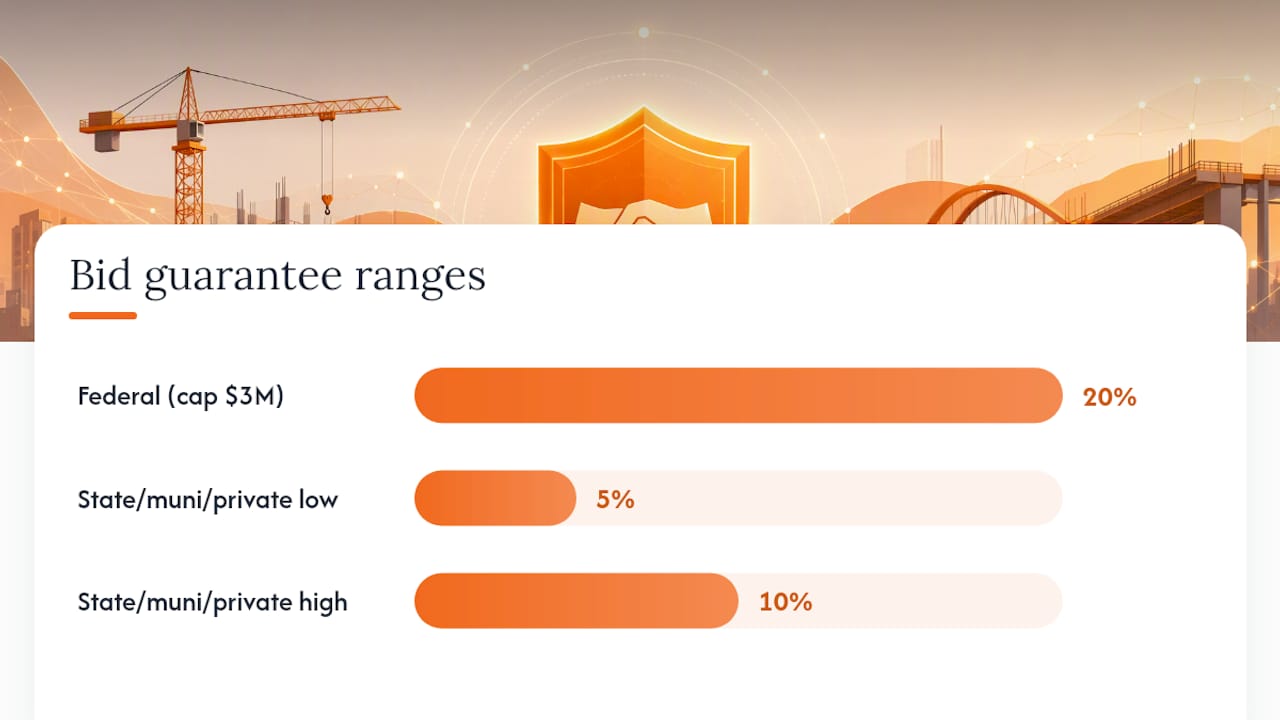
Federal, state, and private owners each set bond percentages differently, and the gap between them catches contractors off guard more often than any other compliance issue. FAR Subpart 28.1 requires a bid guarantee whenever performance and payment bonds are required, and sets that guarantee at a minimum of 20% of the bid price, capped at $3 million unless the contracting officer specifies a different figure. On many federal construction contracts, the Miller Act triggers performance and payment bond requirements once the contract value exceeds $150,000, and that’s usually the same threshold that pulls a bid bond requirement into the solicitation.
State, municipal, and most private-sector owners work differently. Industry guidance from Procore consistently shows bid bonds issued at 5% to 10% of the bid amount for the large majority of public and private projects, well below the federal 20% ceiling. Private owners have more latitude and sometimes waive bonds entirely on smaller jobs, or require a flat dollar amount instead of a percentage.
Quick math: On a $2 million bid at a 10% requirement, your bond penal sum is $200,000. On a federal project at the 20% FAR maximum, that same $2 million bid would need a $400,000 bond, well under the $3 million statutory cap.
| Project type | Typical bond percentage | Governing rule |
|---|---|---|
| Federal construction | Up to 20%, capped at $3 million | FAR Subpart 28.1 |
| Federal (Miller Act threshold) | Triggers at contracts over $150,000 | Miller Act, 40 U.S.C. chapter 31 |
| State and municipal | Commonly 5% to 10% | Agency procurement code |
| Private sector | 5% to 10%, or waived on smaller jobs | Owner discretion |
The percentage always applies to your total bid price, not your profit margin or your labor cost alone. A contractor bidding $8 million at 10% needs an $800,000 bid bond available before submission, whether or not the surety ultimately collects anything.
How Bid Bonds Work: Penal Sum, Bid Spread, and Claim Triggers
The penal sum is the maximum dollar amount stated on the bond form, usually calculated as the required percentage of your bid price. That figure is the ceiling, not necessarily what the surety pays out if something goes wrong.
Here’s where contractors get surprised. Many claims are limited to the bid spread, the dollar difference between your bid and the next-lowest responsive bid, rather than the full penal sum. If you bid $1 million and the second-place bidder came in at $1.05 million, the owner’s actual damages from you walking away are roughly $50,000, and some bond specifications limit recovery to that spread. Other bond forms allow the obligee to pursue the full penal sum regardless of spread, so you need to read the actual bond language in the solicitation rather than assume every bond works the same way.
Pro Tip: Before you finalize your number, ask your estimator to run the bid spread against your second-closest competitor’s likely range. If you’re the low bidder by a wide margin, your exposure on a bid-spread bond is bigger than you think.
Claims typically get triggered by one of two events:
- You win the bid and then refuse to sign the contract within the required timeframe.
- You sign but can’t produce the performance and payment bonds the contract requires.
When either happens, the owner can call the bond, award to the next-lowest bidder, and pursue the difference through the surety. Bid validity periods matter here too. Most solicitations specify how long your bid, and the accompanying bond, stays open for acceptance, commonly 30, 60, or 90 days. If the owner doesn’t award within that window, your bond obligation typically lapses, though some agencies request bid extensions that require a corresponding bond extension from your surety.
When Are Bid Bonds Required, and What Are the Common Exceptions?
Bid bonds show up on the vast majority of federal and public work, but the rules aren’t identical everywhere, and knowing the exceptions can save you from over-preparing or, worse, assuming a bond isn’t needed when it is.
- Federal construction contracts almost always require a bid guarantee when the contract value crosses the Miller Act’s performance and payment bond threshold, per FAR Subpart 28.1.
- State and municipal procurements generally mirror federal practice on larger jobs, particularly anything funded partly through federal grants or infrastructure programs.
- Large private owners, especially in healthcare, education, and industrial construction, frequently require bid bonds as a prequalification tool even without a legal mandate.
- Small private projects often skip bid bonds entirely, relying instead on deposits or simple contractor vetting.
FAR also outlines specific conditions where a contracting officer may waive the bid guarantee requirement: when only one responsive offer is received, during declared emergencies, for certain overseas contracts, or when the contracting officer determines a bond isn’t in the government’s interest. These waivers are the exception, not something to bid on happening.
Noncompliance plays out differently depending on the procurement method. In sealed bidding, a missing or defective bid bond is typically treated as a responsiveness issue. Your bid gets rejected outright, no negotiation, no do-over. In negotiated procurements, contracting officers sometimes have more discretion to request a correction or clarification before disqualifying you. That distinction is exactly why you verify the bond clause the moment a solicitation lands on your desk, not the night before submission.
How to Obtain a Bid Bond: Documents, Timeline, and Costs
Getting bonded starts weeks before you need the bond, not the day of. Sureties want to see a complete underwriting file, and the contractors who keep one ready year-round get approvals in hours instead of days.
Your underwriter will typically ask for:
- The solicitation and specific bond form required (SF 24 or an equivalent).
- Current financial statements, ideally CPA-reviewed or audited for larger bonds.
- Your current backlog and work-in-progress schedule.
- Bank references and a line of credit summary.
- A history of similar completed projects, especially at comparable size and scope.
Autodesk’s guidance for contractors recommends assembling this packet once and keeping it current, rather than rebuilding it for every solicitation. Contractors with an established relationship with a surety agent and a standing underwriting file often get same-day approval on routine bid bonds. First-time applicants or contractors requesting bonds larger than their prior track record can wait a week or more while the underwriter digs deeper.
Cost structure surprises a lot of first-time bidders. According to BondExchange, bid bonds typically don’t carry the kind of premium charged on performance bonds. Many sureties issue them at no direct cost, since the real fee gets collected when the performance and payment bonds are issued after contract award. Some agents charge a flat issuance fee regardless. Underwriting criteria vary by project size and your financial profile, so a contractor with thin working capital may face more scrutiny even on a bond that’s technically free.
Statistic Callout: Federal bid guarantees can run as high as 20% of your bid price, capped at $3 million, per FAR Subpart 28.1, while most state, municipal, and private work sits at 5% to 10% according to Procore’s industry data. Know which bucket your project falls into before you price your bid.
A Compliance Checklist That Catches Errors Before Submission
Most bid bond problems aren’t legal disputes. They’re clerical. Wrong obligee name, missing solicitation number, an unsigned form, or a bond percentage that doesn’t match the addendum issued three weeks earlier. Build these checks into your submission process every time:
- Confirm the obligee name on the bond form matches the solicitation exactly, including agency subdivisions.
- Verify the solicitation number is printed correctly on both the bond and the bid form.
- Match the bond percentage against the current addenda, not the original invitation to bid.
- Confirm the bond form itself is the version specified, since agencies sometimes require SF 24 or a modified equivalent.
- Check that all required signatures and corporate seals are present before the bond leaves your office.
Beyond the checklist, the bigger lever is process. An approval gate that requires a second reviewer to sign off on bond documents before submission catches mistakes a rushed estimator misses. Tracking addenda in one place, rather than across email threads and printed copies, prevents the single most common bond mismatch: pricing a bid off addendum three but attaching a bond calculated off the original solicitation. Keeping a unified packet ready for final performance and payment bonds also speeds up the post-award scramble, since your underwriter has already seen most of what they need.
This is exactly the kind of failure point a structured bid command center is built to close, flagging a bond percentage that doesn’t match the latest addendum before it ever reaches your signature page.
Pro Tip: When in doubt about whether a bond issue is a paperwork fix or a legal problem, call your surety agent first. Reserve legal counsel for situations involving an actual claim, forfeiture demand, or dispute over bid spread calculation.
Where to Verify the Rules Yourself
Don’t take secondhand summaries as the final word on your specific project. Go to the primary sources: FAR Subpart 28.1 covers federal bid guarantee rules directly, and the Miller Act text lays out the performance and payment bond thresholds that often pull a bid bond into scope. For the actual paperwork, GSA’s bid bond form library has the SF 24 series and instructions on required fields like penal sum and signer authority. For plain-language background, Procore’s bid bond guide and Autodesk’s contractor-focused explainer are solid starting points.
Why Contractors Keep Getting Burned by the Same Bond Mistakes
Bid bond disqualifications almost never come from a contractor misunderstanding the concept. They come from a mismatch between the bond and the latest version of the solicitation, usually because an addendum landed after the bond was already ordered. That’s a process failure, not a knowledge gap, and treating it as a knowledge problem is why so many firms keep repeating it.
The contractors who avoid this aren’t necessarily more experienced. They’re the ones who treat bond compliance as a checklist item owned by a specific person, checked at a specific point in the submission process, every single time. Confirm the obligee, confirm the bond percentage against the current addenda, and confirm the deadline before you finalize your bid. Do that consistently, and the paperwork stops being where you lose jobs.
— Rohan
A Faster Way to Catch Bond and Compliance Errors Before Submission
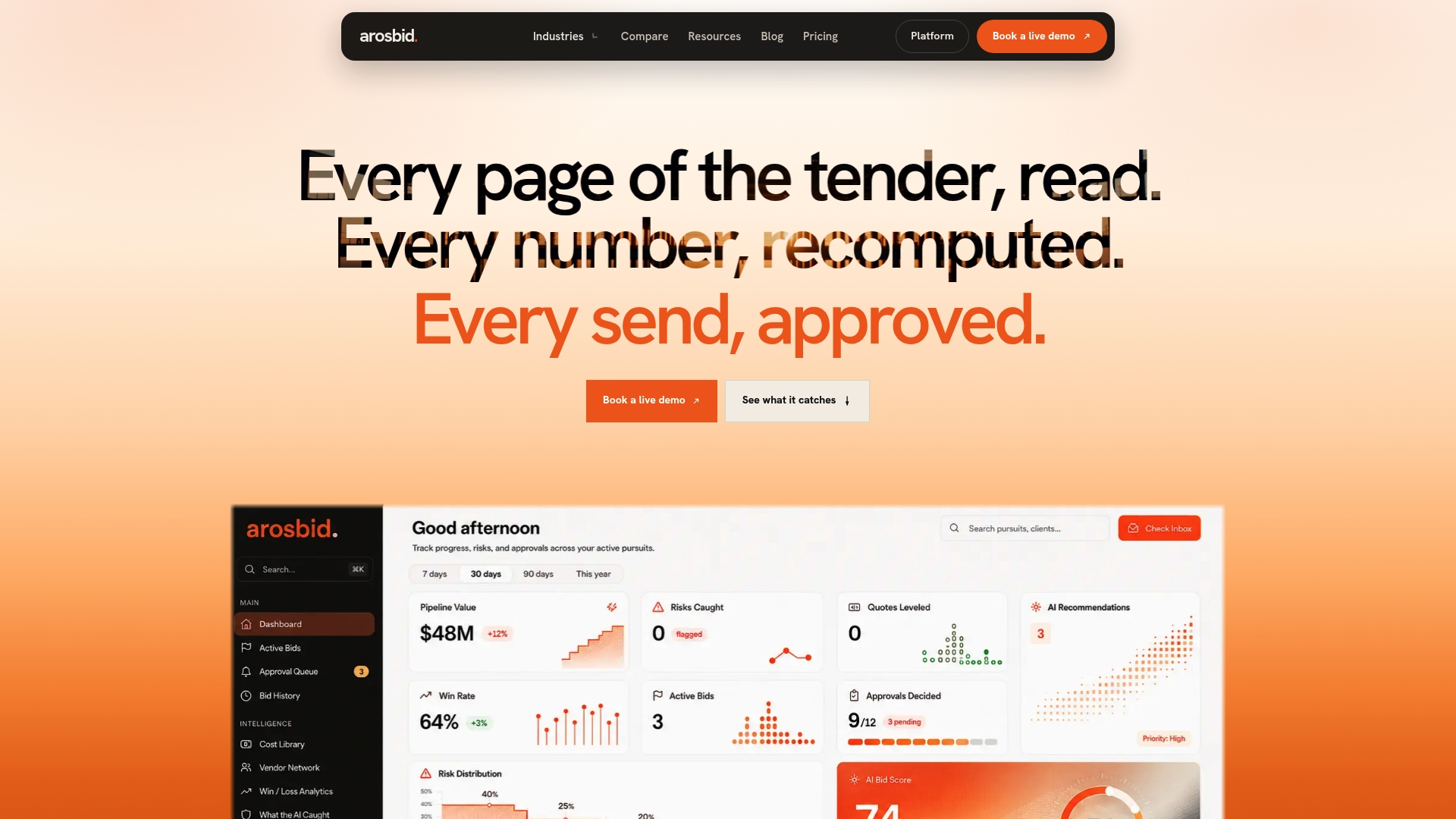
Reading solicitation language line by line under deadline pressure is where bond mismatches slip through, even for experienced estimators. Arosbid closes that gap by tracking addenda automatically, flagging when a bond percentage no longer matches the latest solicitation version, and assembling your compliance documents into one packet instead of scattered email threads and printed copies.
Teams bidding high volume or handling complex multi-trade packages get the most out of this, since that’s where a missed addendum or a stale bond figure does the most damage. If your crew is still cross-checking bond clauses by hand against every revision, it’s worth seeing how the platform handles it instead. Book a live demo and walk through how it flags a bond mismatch before it ever reaches your signature page.