30 Minute Bid Risk Assessment for Estimators: Score, Register, Decide
30 Minute Bid Risk Assessment for Estimators: Score, Register, Decide ! Bid risk assessment title card illustration A bid risk assessment is a structured review of a tender's financial, contractual, technical, schedule, and operational exposure before your team commits estimating hours to it.
A bid risk assessment is a structured review of a tender’s financial, contractual, technical, schedule, and operational exposure before your team commits estimating hours to it. Run a pre-bid screen in under 30 minutes, before costing starts, to catch disqualifiers and margin killers early. Teams using a bid management platform to standardize that screen and log outcomes in a risk register tend to catch problems before, not after, submission.
TL;DR:
- Conducting a quick preliminary review, focusing on financial and payment risks, can prevent margin erosion caused by late discovery of problematic clauses or scope gaps.
- The risk assessment should evaluate eight key categories, including legal, schedule, supply chain, and reputational risks, during the same document scan for consistency.
- Prioritizing risks based on a probability-impact matrix and ensuring they are linked to specific mitigations helps determine whether to proceed with or abandon a bid.
- Using a centralized risk register with clear ownership and documented assumptions improves risk management and supports effective decision-making throughout the bid process.
- Implementing software like ArosBid automates document review, risk scoring, and register updates, enabling teams to perform a thorough risk assessment in about a day without manual workload.
Table of Contents
- Why Front-Loading Risk Review Protects Your Margin
- What Risk Categories Should You Check in Every Bid?
- How Do You Score and Prioritize Bid Risks?
- Building a Bid Risk Register That Actually Gets Used
- When Should You Assess Risk During the Bid Process?
- How ArosBid Operationalizes the Bid Risk Framework
- Our Take: The One Habit That Actually Moves the Needle
- Try ArosBid for Your Next Bid Cycle
- Sources
- FAQ
Why Front-Loading Risk Review Protects Your Margin
Most bid teams find out about a problem clause, a missing scope item, or a payment term that kills cash flow after they have already sunk 20 hours into the estimate. That is the expensive way to learn. Late risk discovery does not just cost estimating time. It erodes margin through change-order fights, invites penalties from clauses nobody flagged, and pulls project managers off active jobs to firefight a bid they should never have chased.
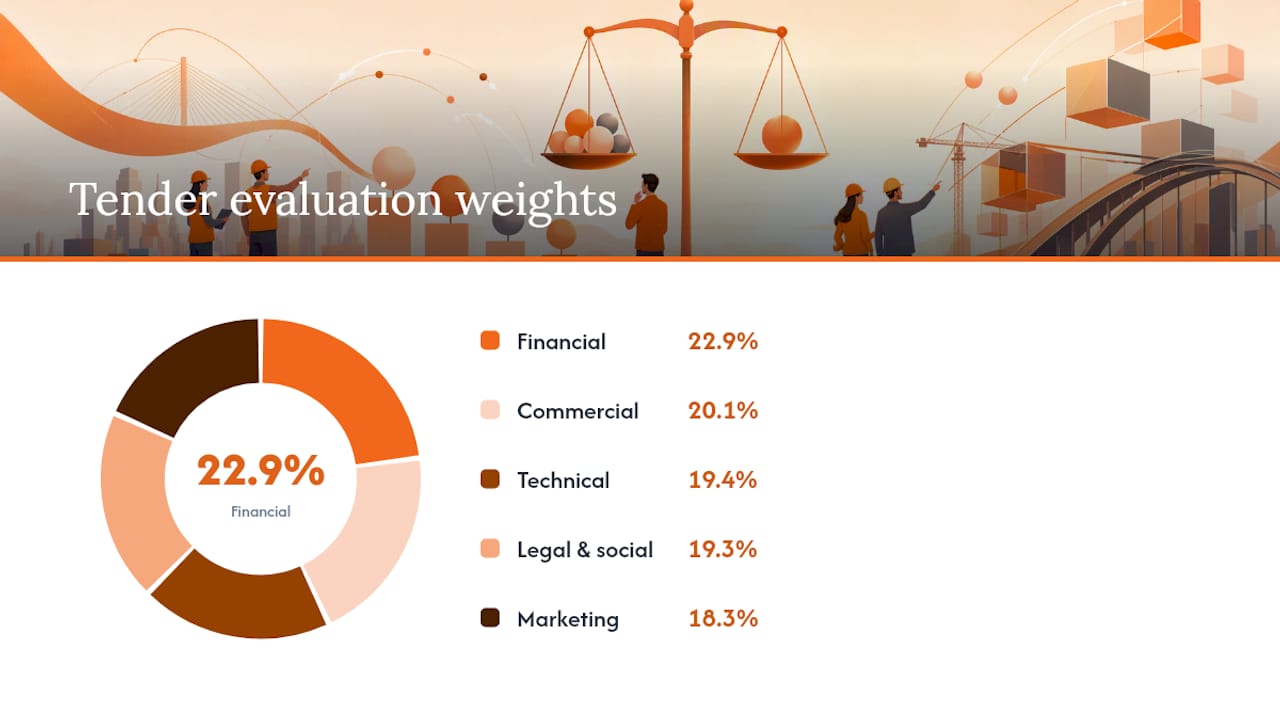
A 2026 study on pre-tender assessment found financial aspects carry the highest weight in tender evaluation, at 22.9%, ahead of commercial factors (20.1%), technical concerns (19.4%), legal and social considerations (19.3%), and marketing aspects (18.3%). That ranking tells you where to spend your first ten minutes of review: payment terms and financial exposure outrank almost everything else on the checklist.
Front-loading the screen pays off in three concrete ways:
- Fewer last-minute price hikes. Catching a long-lead material clause or an escalation gap in week one means you price it correctly, not fix it three days before submission.
- Clearer assumptions for subcontractors. When your team documents scope gaps early, subcontractor quotes come back aligned instead of full of exclusions you discover at leveling.
- Less sunk-cost pressure. A short strategic screen up front, according to industry framework research, prevents the psychological trap of continuing to chase a bad-fit project just because your team already spent hours on it.
The pattern shows up across trades: the bids that blow margin almost always had a visible red flag in the first document scan. Someone just did not stop to read for it.
What Risk Categories Should You Check in Every Bid?
Every tender carries risk across eight recurring categories. Working through them in order, during the same document pass, keeps your review consistent whether the estimator on duty has done this ten times or a hundred.
Financial and payment risk. Look at payment terms, retention percentage, bonding requirements, and liquidated damages caps. Red flag: retention above 10% combined with net 60 payment terms, or liquidated damages with no cap tied to contract value.
- Confirm payment schedule and retention release conditions.
- Check bonding and insurance requirements against your current capacity.
- Verify liquidated damages language has a cap.
- Scan for pay-when-paid clauses that shift owner nonpayment risk to you.
Contract and terms risk. Read the front-end conditions, not just the technical specs. Red flag: indemnification language that extends beyond your own negligence, or a termination-for-convenience clause with no compensation for work in progress.
- Check indemnification and limitation-of-liability clauses.
- Confirm dispute resolution method and jurisdiction.
- Look for one-sided change-order approval language.
Scope, BOQ, and design risk. Compare the bill of quantities against the drawings line by line where you can. Red flag: quantities that do not reconcile with the drawings, or design documents marked “for coordination” with no final issue date.
- Cross-check BOQ quantities against drawing takeoffs.
- Note any performance specs without a defined basis of design.
- Flag incomplete or “issued for tender” drawings that aren’t final.
Schedule and market risk. Red flag: a completion date that assumes zero weather delay in a region where that is not realistic, or a start date tied to a permit that has not been issued.
Operational and delivery risk. Red flag: crew or equipment requirements that exceed your current bench strength without a clear subcontracting plan.
Subcontractor and supply chain risk. Red flag: single-source materials with lead times that exceed the project schedule, especially on steel, mechanical equipment, or specialty glazing.
Legal and compliance risk. Cross-reference licensing, prevailing wage, and safety certification requirements against your current standing. UK tenders in particular often reference specific procurement legislation that carries binding compliance obligations, not boilerplate.
Reputational and external risk. Red flag: a public-sector owner with a history of disputed claims, or a project location with active community opposition that could delay permits.
Pro Tip: Keep a one-page category checklist taped inside your bid folder. The teams that skip categories under deadline pressure are always the ones surprised by a claim six months into the job.
How Do You Score and Prioritize Bid Risks?
Once you have identified risks by category, you need a way to rank them so your team spends mitigation time where it matters, not on every minor flag equally. The standard method is a probability × impact matrix.
Rate likelihood on a simple scale from low to high based on your history with similar projects or owners. Similarly, rate impact from minor to severe effect. Combine these to create a risk score to guide prioritization and action.
A worked example: a subcontractor supply risk on structural steel with a significant lead time gap scores high on both likelihood and impact, landing in the severe risk category. This requires either a firm lead-time commitment from your supplier before pricing or a schedule contingency line large enough to cover the gap.
To convert individual scores into a go/no-bid signal, sum the priced contingency value of every moderate-and-above risk and divide by total contract value. One tender risk framework recommends treating cumulative exposure above roughly 8 to 10% of contract value as a threshold for serious no-bid consideration, adjusted for your own risk appetite and backlog needs. The exact cutoff matters less than having one at all:
- Score every identified risk on likelihood and impact.
- Sum the priced contingency for moderate, high, and severe items.
- Divide that sum by total contract value to get exposure percentage.
- Compare against your firm’s threshold and route the decision accordingly.
Building a Bid Risk Register That Actually Gets Used
A risk register that lives in a forgotten spreadsheet tab helps nobody. A register earns its place only when every entry has a named owner and a mitigation tied to a specific pricing action, a point practitioner guidance on construction risk assessment makes directly.
Build your register with these fields, no more and no fewer:
- Description: plain-language statement of the risk.
- Source: which document or clause it came from.
- Likelihood and impact: the 1 to 5 scores from your matrix.
- Risk score: the multiplied total.
- Mitigation: the specific action taken.
- Owner: one named person, never a department.
- Pricing assumption: the dollar figure or contingency line it feeds.
- Status: open, mitigated, priced, or closed.
- Review date: when it gets revisited.
Every register entry should resolve into one of three outcomes. First, a priced contingency line added to your estimate, documented with the exact assumption behind it. Second, an RFI sent to the owner or architect to close the information gap before you price around it. Third, a contractual qualification attached to your submission that explicitly excludes or limits your exposure to that risk.
When information stays missing and no RFI response arrives in time, the disciplined move is to document the assumption explicitly, price it as a visible contingency, and get executive sign-off rather than quietly absorbing it into overhead.
Three operational rules keep the register from turning into dead weight:
- Assign exactly one owner per risk. Shared ownership means nobody actually monitors it.
- Set a review cadence. Weekly during active bidding, tied to each pricing milestone.
- Require sign-off from a commercial or executive reviewer before any severe-band risk gets waived rather than priced.
Public-sector buyers score submissions higher when the bid can show named owners and monitoring cadence baked into its risk approach, a pattern tender risk management guidance confirms directly from procurement evaluation criteria.
When Should You Assess Risk During the Bid Process?
Risk assessment is not a single event. It runs on a time-boxed sequence that should not add more than a day of total effort spread across the bid cycle.
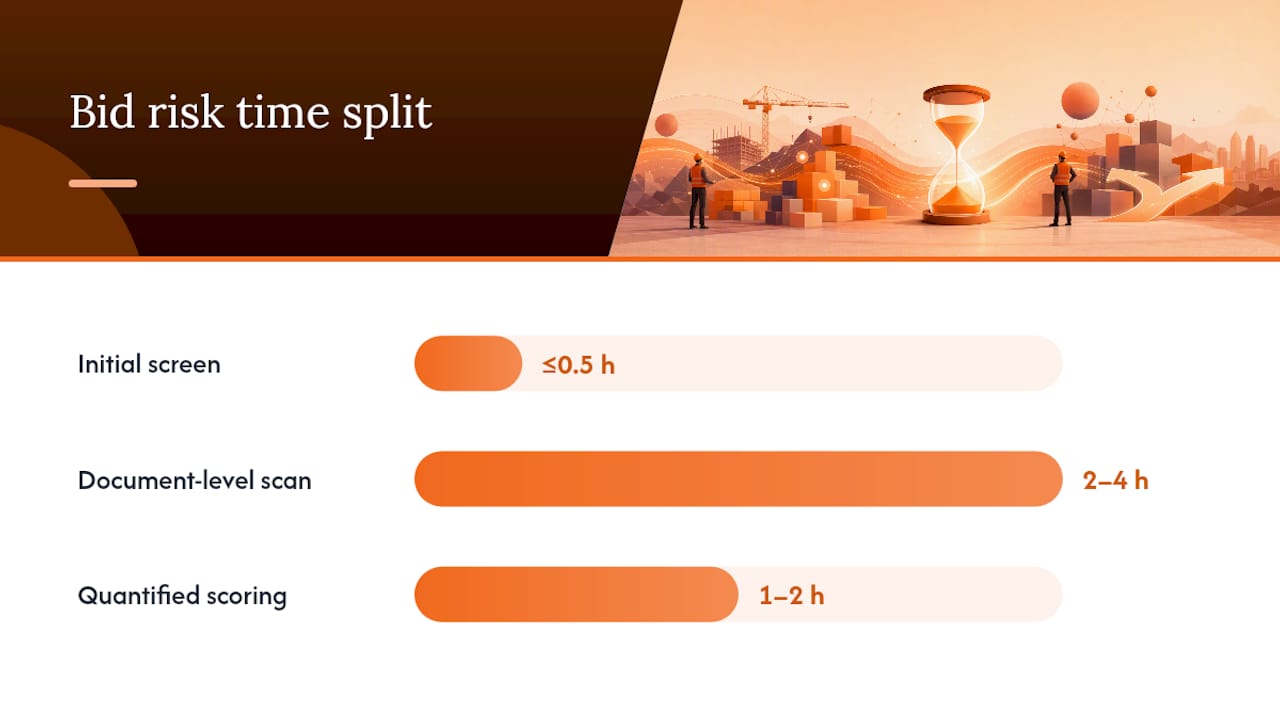
- Initial screen, 30 minutes or less. Read the invitation to bid, owner name, and top-line terms. Decide whether this bid clears the bar to even open the full document set.
- Document-level scan, 2 to 4 hours. Read every page of the front-end conditions, specs, and drawings against your category checklist. This is where most red flags surface.
- Quantified scoring, 1 to 2 hours. Score every flagged item on the probability × impact matrix and total the exposure percentage.
- Pre-price review and final signoff, before the number goes out the door. Commercial or legal reviews severe-band items, operations confirms delivery assumptions, and the bid manager signs off on the final go decision.
Different people own different stages. The estimator typically runs the document scan since they are reading the drawings anyway. Commercial or legal reviews contract language and financial terms. Operations weighs in on schedule and delivery feasibility. The bid manager owns the final go/no-bid call and signs off before submission.
Use RFIs and addenda actively during this window, not as an afterthought. Every unresolved ambiguity you push into an RFI is a risk you move off your own book and onto the owner’s, at least until they answer it.
Pro Tip: Set a hard cutoff for RFI submissions, typically 5 to 7 business days before bid due date. An RFI answer that arrives after you have already locked pricing is worse than no answer at all, because now you know about a problem you cannot reprice.
A parallel risk management process run alongside bid preparation on design-build projects specifically helps surface owner-information gaps early enough to still clarify them before the number locks, which matters even more when the design is incomplete at bid time.
How ArosBid Operationalizes the Bid Risk Framework
Running this framework by hand across dozens of live bids is where teams fall behind, not because the logic is hard, but because nobody has time to reread every clause manually under deadline.
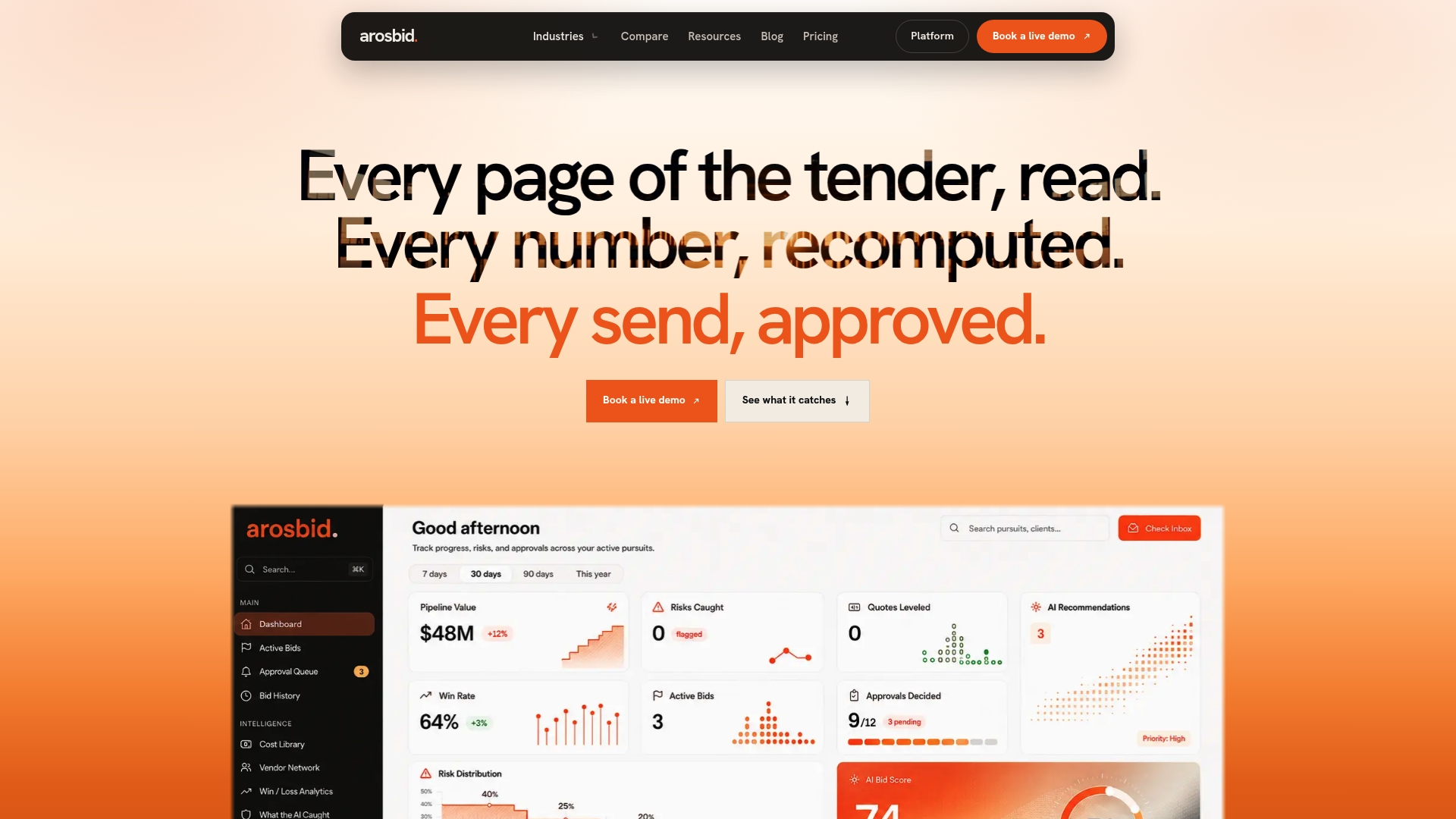
ArosBid’s document review feature scans the full bid package, front-end conditions included, and flags missed clauses, conflicting specifications, and BOQ inconsistencies at the pace your document-level scan needs, not the pace a tired estimator manages at 11 PM. Automated document analysis applied at scale catches deviations a manual read can miss on page 340 of a spec book.
The register lives centrally rather than in a forgotten spreadsheet, with quote tracking and approval workflows tied to the same command center your team already checks daily. Every risk score, mitigation, and pricing assumption stays attached to the bid record, so when a project manager asks six months later why a contingency line exists, the answer is already documented.
Our Take: The One Habit That Actually Moves the Needle
If you adopt one thing from this article, make it a document-first, risk-led go/no-bid habit. Read the front-end conditions and BOQ before anyone opens an estimating spreadsheet, score what you find, and let the exposure number drive the decision instead of gut feel or backlog pressure.
Measure the win in two places: fewer disqualifications from missed clauses, and better margin capture on the bids you do win, since your pricing now reflects real assumptions instead of guesses. Keep the register intact after award. It becomes your best debrief tool when a project manager asks what you knew going in.
— arosbid team
Try ArosBid for Your Next Bid Cycle
You have the framework now: screen, scan, score, register, decide. Some software tools run this exact sequence without requiring teams to build a matrix in Excel from scratch every week. These platforms read the full document set, keep the risk register centralized instead of scattered across shared drives, and track approvals to ensure severe risks are not waived without a sign-off trail.
Three plans fit different bid volumes: One Desk for a single estimator running a steady bid pipeline, The Department for a team coordinating across multiple active tenders, and The Whole Year for firms bidding continuously across a full calendar. Pricing for each is available on the ArosBid pricing page. If you want to see the document scan and register in action before committing, book a live demo and bring your next bid package with you.
Sources
- Scientific Contributions Oil and Gas — 2026 study
- BlackSwanAI blog — Systematic tender risk assessment
- Bidwell — Tender risk management
FAQ
What Should a Bid Risk Assessment Include?
A solid bid risk assessment covers five elements: risk identification by category, a probability and impact score for each item, a named owner, a documented mitigation tied to a pricing action, and a review date. Skipping the owner or the pricing link is the most common reason registers stop getting used.
What Are the Main Risks of Bidding on a Project?
The biggest risks fall into financial terms, unclear contract language, scope gaps between drawings and the bill of quantities, unrealistic schedules, and subcontractor supply chain delays. Financial risk carries the heaviest weight in pre-tender evaluation, ahead of commercial, technical, legal, and marketing factors.
What Are the Main Steps in a Bid Risk Assessment?
Run an initial screen in 30 minutes or less, follow with a document-level scan of 2 to 4 hours, score every flagged risk on a probability × impact matrix, then complete a pre-price review before final signoff. This sequence, drawn from systematic risk assessment practice, keeps total added effort to about a day spread across the bid cycle.
What Are the Different Types of Risk to Check in a Tender?
Practitioners generally group bid risk into eight categories: financial and payment, contract and terms, scope and design, schedule and market, operational and delivery, subcontractor and supply chain, legal and compliance, and reputational risk. Checking all eight during the same document pass keeps the review consistent across estimators.
How Can ArosBid Help With Bid Risk Assessment?
ArosBid’s document scanning feature reviews the full bid package for missed clauses and conflicting specifications, while its centralized register tracks scores, owners, and pricing assumptions in one place. Current plan pricing is listed on the ArosBid pricing page.