Quote Comparison Matrix: Trade Templates and Checklist for Estimators
Quote Comparison Matrix: Trade Templates and Checklist for Estimators ! Construction quote comparison matrix title card A construction quote comparison matrix is the leveled, scope-based table that lines up subcontractor bids against one scope baseline and produces a normalized total for every bidder.

A construction quote comparison matrix is the leveled, scope-based table that lines up subcontractor bids against one scope baseline and produces a normalized total for every bidder. That normalized number, not the sticker price on the proposal, is what you should use to award the package. Building one right means fixing the scope baseline before bids land, then flagging every gap with a documented plug number or a written bid clarification request (BCR). Such platforms mostly exist to speed up that flagging step.
TL;DR:
- Building a scope baseline from drawings and specs before bids arrive is essential; adjusting it afterward leads to contaminated comparisons.
- Use a standardized, trade-specific template with documented sources and metadata to ensure accuracy and facilitate dispute resolution.
- Mark scope status as included, excluded, or unclear, and resolve every unclear or excluded item with a documented plug number from a reliable source.
- Keep the normalized bid as a living figure, regularly updating it with BCR responses and revisions to maintain accurate ranking.
- Automating data extraction and quote leveling reduces manual work, allowing more focus on assessing scope risk, exclusions, and bidder qualifications.
Table of Contents
- What Every Construction Quote Comparison Matrix Needs
- Build a Reusable Template Instead of Starting Over
- How to Populate the Matrix and Flag Scope Gaps
- Normalizing Totals and Scoring Beyond Price
- What Belongs in the Award Recommendation Package
- How ArosBid Handles the Repetitive Parts of Leveling
- Best Practices for Verifying Bidder Information Before You Build the Matrix
- Handling Bids That Won’t Fit the Matrix Cleanly
- Presenting the Matrix to Stakeholders
- Keeping the Matrix Current Through Negotiation and Revisions
- What to Prioritize When Bids Arrive Late and Time Is Short
- Automate the Leveling Grind Without Losing the Judgment Calls
- Sources
What Every Construction Quote Comparison Matrix Needs
The matrix only works if the scope baseline exists before the first bid opens. Build it from the drawings and specs, not from whatever the lowest bidder happened to include. If you let the baseline follow the bids, you’re leveling against a moving target, and every comparison downstream is contaminated.
The structure itself is simple. Rows carry scope line items pulled straight from the baseline. Columns carry each bidder. Cells carry a status: included (INC), excluded (EXC), or unclear, meaning the proposal doesn’t say either way. Procore’s construction bidding library frames this as adjusting for discrepancies so bids sit on identical terms, and that adjustment is the entire point of the exercise.
Beyond the INC/EXC/UNCLEAR grid, a working matrix needs a handful of supporting columns:
- Base bid total as submitted, unadjusted
- Allowances and what they actually cover
- Documented exclusions, quoted from the proposal language
- Plug number adjustments for anything excluded, with a source
- Normalized total (base bid plus every plug adjustment)
- Notes field for qualifications, conditions, or reviewer comments
Skip any one of these and you’re back to comparing apples against a vague sense of oranges. The normalized bid formula MeltPlan describes works precisely because it forces every excluded item back into the total before anyone compares numbers.
Build a Reusable Template Instead of Starting Over
A template you rebuild from scratch every bid package is a template that will eventually miss something. Standardize once per trade and reuse it.
At minimum, your template needs these fields locked in before the first quote arrives:
- Scope line items pulled from the baseline, grouped by system or area
- Bidder identity and contact, plus the document source for each quote
- INC/EXC/UNCLEAR status cells, one column set per bidder
- Plug number and adjustment source columns
- Metadata: who entered the data, entry date, and the BCR ID if one was issued
That metadata row matters more than it looks. When a dispute comes up three months into construction, “who entered this and where did the number come from” is the question everyone asks, and a matrix without an answer is a liability.
Pro Tip: Keep one template per trade, not one template for the whole project. A mechanical package and a roofing package exclude different things by default, and a generic template misses the exclusions each trade routinely leaves out.
Store templates in a shared library your team actually uses, version them when you change a column, and note the change date. Firms that keep a consistent trade-specific template report fewer rebuild hours and catch more of the scope items subs habitually leave out.
How to Populate the Matrix and Flag Scope Gaps
Read qualifications and exclusions before you read the price. That’s not a suggestion, it’s the order that actually surfaces risk. A number without its exclusions attached tells you nothing about what you’re really being quoted, and Pivotly’s guidance on leveling mismatched bids makes the same point: no two subs format a proposal the same way, so the qualifications section is where the real scope lives.
Work line by line against the baseline:
- Mark INC when the bidder’s language explicitly covers that scope item
- Mark EXC when the proposal explicitly excludes it or excludes it by omission from a listed scope
- Mark UNCLEAR when you genuinely cannot tell, which means you need to ask, not guess
UNCLEAR should never sit unresolved on a final matrix. It’s a flag to act on, not a permanent status. Set a threshold for what triggers a written BCR rather than a phone call: anything that could swing the total by a meaningful percentage, or anything touching life safety, structural connections, or long lead equipment, gets a written request with a documented response. Verbal clarifications evaporate; written ones become part of the award record.
For every EXC or UNCLEAR item you resolve without a sub’s confirmed number, you need a plug number, and that plug needs a source. Pull it from a comparable bidder on the same package, a recent historical job, or a published cost benchmark, and write down which one you used and who approved it.
Pro Tip: Never plug a number from memory. If you can’t point to where it came from six weeks from now, the number won’t survive a challenge from the losing bidder.
Normalizing Totals and Scoring Beyond Price
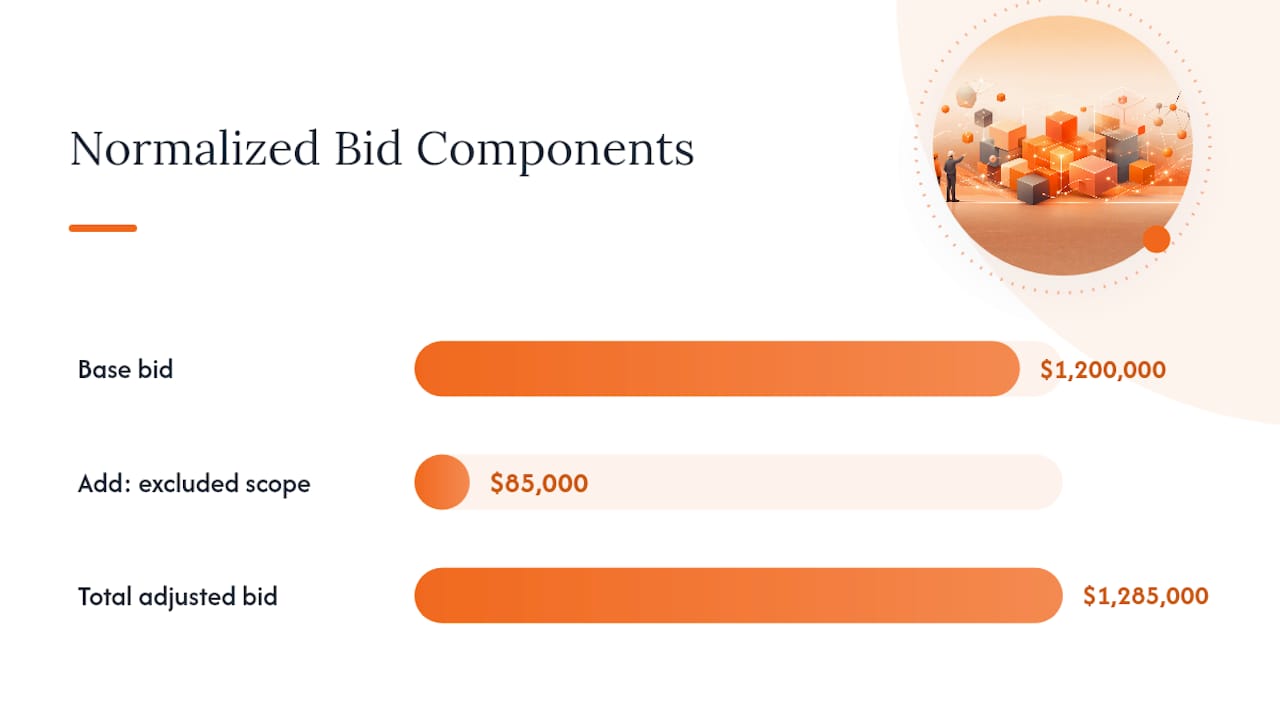
The normalized total is arithmetic, not opinion: base bid, plus every plug number for excluded or unclear items, minus any double-counted allowance, equals the number you rank on. A bidder who submits $1,200,000 but excludes $85,000 of demolition work everyone else included isn’t actually the low bidder once you add that $85,000 back in. That’s the entire reason the Datagrid guide to bid leveling treats the standardized leveling sheet, base bid, inclusions, exclusions, allowances, adjustments, total adjusted bid, as the industry baseline structure rather than an optional add-on.
Keep a sign convention and stick to it. Additions to the total are positive, credits are negative, and every adjustment row states its source in plain language: “per Bidder B’s identical scope,” “per historical job 4471,” “per RSMeans line item.” Mixed sign conventions are how normalized totals get miscalculated at 11pm the night before an award meeting.
Price alone won’t tell you who to award, especially on complex packages. A short weighted rubric handles the rest:
- Normalized price, roughly 50 to 60% of the score
- Schedule commitment and crew availability, 15 to 20%
- Completeness of qualifications and clarity of exclusions, 15%
- Bonding, safety record, and risk profile, 10 to 15%
Where estimators lose credibility fastest: normalizing a bid once and never touching it again after a BCR response changes the number. A normalized total is only accurate as of the last update. Treat it as a living figure, not a one-time calculation.
The most common normalization mistake isn’t math, it’s scope. Estimators double count an allowance already included in the base bid, or they forget to remove a credit once a bidder confirms coverage. Recheck every adjustment against the original proposal language before you finalize a ranking.
What Belongs in the Award Recommendation Package
The leveled matrix by itself isn’t a decision, it’s evidence. The award package built from it needs a specific set of contents so anyone reviewing the file later, an owner, an auditor, your own PM six months from now, can reconstruct exactly why the winning bid won.
- The leveled matrix itself, with every cell status visible and every plug number sourced
- Ranked normalized totals for all bidders, not just the recommended one
- A written award rationale tying the recommendation to price, schedule, and risk factors
- A log of outstanding BCRs and their responses, dated and attributed
- A record of who approved each plug number and what evidence backed it
- Draft scope letter language pulling directly from the resolved exclusions
That last item closes the loop. Every EXC or UNCLEAR item you resolved during leveling needs to land explicitly in the scope letter and eventually the subcontract, or the clarification you fought for evaporates the moment the contract gets signed.
How ArosBid Handles the Repetitive Parts of Leveling
Most of what eats an estimator’s day in bid leveling isn’t judgment work, it’s transcription: pulling numbers out of a dozen differently formatted PDFs and typing them into a spreadsheet. That’s the part worth automating.
Some platforms’ approach focuses on a few specific tasks in that workflow:
- Intake and extraction of quote data from PDFs, emails, and spreadsheets into a structured matrix
- Linking every extracted number back to the exact page and line in the source document, so provenance survives QA review instead of getting lost between the proposal and the spreadsheet
- Vendor quote leveling that flags mismatched scope automatically rather than waiting for a manual line-by-line read
- Integration with Excel and Outlook, so the matrix output slots into workflows your team already runs rather than replacing them
None of that replaces the judgment call on which plug number to trust or which BCR actually matters. What it removes is the hours spent retyping numbers and hunting through a PDF to confirm where a figure came from. Firms running structured vendor quote leveling inside a shared command center tend to spend that reclaimed time on the qualification review that actually catches risk, not on data entry.
Best Practices for Verifying Bidder Information Before You Build the Matrix
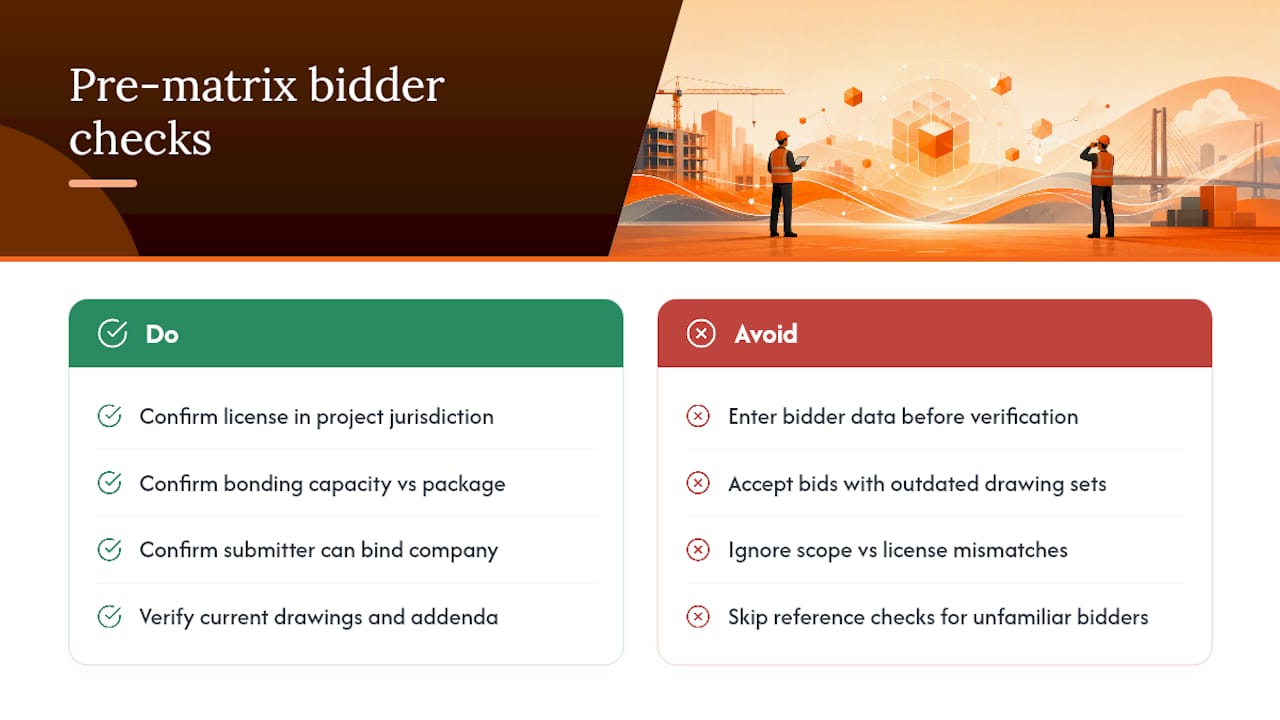
A matrix built on unverified bidder data is a matrix you’ll rebuild. Before you create a single row, confirm three things about every bidder on the list: licensing status in the project’s jurisdiction, current bonding capacity against the package size, and whether the contact submitting the quote actually has authority to bind the company.
Cross-check the bidder’s scope of work against their trade license category. A mechanical contractor bidding controls work outside their license classification is a red flag worth a phone call before you ever enter their number into the matrix. The same goes for insurance certificates. Confirm coverage limits match your contract requirements before leveling starts, not after you’ve already picked a winner.
Verify the bid was submitted on your current drawing set and addenda. A bidder working from an outdated set will look artificially competitive because they priced less scope, and that gap won’t show up until you compare exclusions line by line. Ask for confirmation of addenda receipt in writing, and log the response with a date.
For packages with new or unfamiliar bidders, a basic reference check, a call to a recent GC or owner they worked for, catches performance problems no bid tabulation will ever reveal. Pair that with a look at how the bidder handles pre-construction verification steps on their own end. Contractors who document their own subcontractor vetting process tend to produce cleaner, more complete bids in the first place.
None of this needs to be exhaustive for every package. Scale the verification effort to the package’s dollar value and risk profile. A $40,000 painting sub doesn’t need the same scrutiny as a $4 million structural steel package.
Handling Bids That Won’t Fit the Matrix Cleanly
Flagging an ambiguous cell as UNCLEAR is step one, not the finish line. Some bids resist even that simple classification, and you need a second layer of method for the ones that stay genuinely murky after a first pass.
Start by separating true ambiguity from lazy proposal writing. A bidder who writes “electrical per plan” without specifying which revision of the plan is being ambiguous by omission, and a direct written question usually resolves it fast. A bidder who provides a lump sum with zero line-item breakdown is a different problem entirely: you can’t level what you can’t decompose. For those, request a schedule of values before you attempt to place a single number in the matrix. Refuse to level an undecomposed lump sum against itemized competitors; the comparison is meaningless until it’s broken apart.
For allowances stated without a basis, treat every one as a question, not a number. An allowance for “electrical fixtures, $15,000” tells you nothing about whether that figure matches your spec grade. Pivotly’s approach to mismatched bids treats this exact situation as one of the most common sources of false apples-to-apples comparisons, since two bidders can carry identical dollar allowances covering wildly different fixture quality.
When a bidder simply never responds to a BCR before your deadline, don’t leave the cell blank and hope. Set a firm cutoff, document the unanswered request in the notes column, and either plug the item using the most conservative comparable number available or exclude that bidder from consideration for that specific package, with the reasoning recorded in the award file.
Presenting the Matrix to Stakeholders
A raw matrix, full of INC/EXC codes and plug numbers, means little to an owner or executive who wasn’t in the weeds during leveling. Translate it before you present it, not during the meeting.
Lead with the ranked normalized totals, not the submitted totals. Showing submitted numbers first anchors the room on the wrong figure, and you’ll spend the rest of the meeting explaining why the “cheapest” bid isn’t actually the lowest. Put the normalized ranking on the first slide or the top of the page, full stop.
Follow that with a short rationale section in plain language: why the recommended bidder ranks where they do, what got added to their total and why, and what risk factors pushed a lower bidder down the list if that happened. Stakeholders don’t need every plug number’s derivation in the room, but they need to trust that each one has a documented source, so keep the full matrix available as backup, not as the headline.
Bring the outstanding BCR log to the meeting even if every question has been answered. It shows the process was rigorous, and it gives you a ready answer if someone asks “did you check on X.” An award recommendation backed by a visible clarification trail moves through approval faster than one that just shows a spreadsheet and a number.
If schedule or bonding concerns influenced the ranking, show the weighted scoring alongside price, not as a footnote after the fact. A stakeholder who only sees price and then hears “but we recommend the second-lowest bidder” without the scoring rationale visible will push back, reasonably.
Keeping the Matrix Current Through Negotiation and Revisions
A quote comparison matrix isn’t a document you finalize once and file away. Bids get revised, addenda get issued mid-negotiation, and BCR responses trickle in over days or weeks. Every one of those events needs to hit the matrix before you rely on it again.
Set a version number and date stamp on the matrix itself, and update both every time a bidder revises a number or a BCR response changes an EXC to an INC. Treat the matrix like a live document with a change log, not a static export you regenerate from scratch each time something shifts. Rebuilding from zero after every revision wastes time and risks losing track of earlier resolved clarifications.
When a bidder submits a revised proposal mid-negotiation, replace their column entirely rather than editing individual cells, and note the revision date in the metadata row. Partial edits scattered across a column are how old and new numbers get mixed by accident.
If a scope change affects the baseline itself, addenda issued after bids were due, for instance, flag every bidder’s response to that addendum in a dedicated column rather than folding it silently into the existing scope rows. You want a clear record of who acknowledged the change and adjusted their price versus who didn’t.
Re-run the normalized totals and re-rank the field after any update that touches a price or an exclusion status. A ranking calculated before a BCR response came in is stale the moment that response lands, and presenting a stale ranking to stakeholders is how award recommendations get challenged later.
What to Prioritize When Bids Arrive Late and Time Is Short
When the schedule collapses and full leveling isn’t possible before a decision, triage by dollar value and risk, not by whichever bid happened to arrive first. Level the largest packages and anything touching structural, life safety, or long lead items completely. Everything else can run on a lighter pass.
Mark any package that wasn’t fully leveled as exactly that in the award file, not as complete. A partial review presented as a full one is where disputes start. If you must shortcut, still document every plug number you use and set a hard BCR deadline, even a short one, rather than skipping the written request entirely.
Speed and defensibility aren’t actually in conflict here. The fastest path through a compressed schedule is still a documented one, just a leaner version of the same process.
— arosbid team
Automate the Leveling Grind Without Losing the Judgment Calls
Some platforms give estimators a faster way through the part of leveling that eats the most hours without adding the most value: pulling numbers from mismatched proposals and typing them into a matrix by hand. They handle intake and extraction from PDFs and emails, link every figure back to its source page, and level vendor quotes automatically, all while running inside Excel and Outlook workflows your team already knows.

That means less time reconciling formats and more time on the calls that actually decide an award: which exclusions carry real risk, which plug number needs a second opinion, and which bidder’s qualifications deserve a phone call before the deadline. Estimators working across multiple trade packages get a command center that tracks BCRs, compliance flags, and vendor quotes in one place instead of scattered spreadsheets.
If your current process still means rebuilding a matrix from scratch every bid cycle, book a demo and see how arosbid’s leveling workflow fits into what your team already runs.
Sources
- How to Level Subcontractor Bids: A Step-by-Step Process for GC Estimators | MeltPlan
- Leveling Subcontractor Quotes When No Two Bids Match | Pivotly
- Bid Leveling: Compare Subcontractor Bids Apples-to-Apples | Datagrid