Construction Bid Lessons Learned: 48 Hours, One Action per Lesson
Construction Bid Lessons Learned: 48 Hours, One Action per Lesson ! Construction bid lessons title card with sketch details Run short, time-boxed debriefs at stage-end and after outcomes, capture one clear action per lesson, and assign an owner, then repeat the cycle on every bid.

Run short, time-boxed debriefs at stage-end and after outcomes, capture one clear action per lesson, and assign an owner, then repeat the cycle on every bid. A simple register and a short review cadence turn scattered feedback into real improvement, rather than notes that sit unread until the next loss repeats the same mistake.
TL;DR:
- Hold internal reviews within 48 hours of each stage, then schedule client debriefs within one to two weeks of the award notice.
- Include the estimator, proposal lead, and compliance reviewer internally; use a neutral facilitator for sensitive client feedback and reserve 20 to 30 minutes.
- Ask about selection criteria, proposal improvements, fee confusion, and the winning firm’s advantage; these specifics produce more useful feedback than asking why you lost.
- Record each lesson that day with its cause, one action, an owner, and a due date, then review open items at every bid kickoff.
- Update the team’s checklists with assigned fixes, then review the next bid to confirm they worked and track compliance errors across three bids.
Table of Contents
- When to run lessons-learned and debrief sessions
- Who to involve, roles, and who should run the debrief
- Step-by-step debrief runbook and sample questions
- Capturing, tracking, and turning lessons into assigned actions
- How to make sure lessons change future bids
- Practical toolbox: when to automate and how a bid command center helps
- Leading a bid team that learns
- How ArosBid helps operationalize lessons learned
- FAQ
- Sources
When to run lessons-learned and debrief sessions
Timing decides whether a debrief produces anything useful. Hold a short review at the end of each major stage, estimating, proposal assembly, and the final compliance check, while details are still fresh and specific. A separate, slightly longer session belongs right after the outcome: a quick wash-up within a day or two of submission, then a scheduled loss or win debrief once the client decision is confirmed.
Delay is the most common way debriefs lose value. The AIA’s best-practice guidance on loss debriefs identifies waiting too long after the decision as one of the recurring mistakes that weakens the quality of feedback, since clients forget specifics and interest in giving detailed answers fades.
A few timing rules keep sessions useful:
- Book the client debrief within one to two weeks of the award notice.
- Run the internal stage-end review within 48 hours of finishing that stage.
- When the team is stretched, default to a 10 to 20 minute quick debrief instead of skipping the session entirely.
A short session held on time beats a thorough one held late.
Who to involve, roles, and who should run the debrief
The right people in the room matter as much as the questions asked. For an internal debrief, include the estimator, the proposal lead, and whoever managed compliance checks; for a client-facing loss debrief, the bid lead and, where the relationship allows it, the account owner. Each attendee should arrive having reviewed their own section of the submission, not just the final result.
A curious, non-defensive facilitator gets better answers than someone who was personally invested in the outcome. The AIA guidance notes that choosing the wrong interviewer, often someone too close to the bid, is a common mistake that makes clients soften or withhold feedback. When a loss touches a strategic account or the feedback is likely to be sensitive, a third-party facilitator tends to draw out more candid answers than an internal one.
Prep checklist before the session:
- Each attendee reviews their section and brings one open question.
- The facilitator confirms the client contact and sets a 20 to 30 minute window.
- Someone is assigned to take notes and log actions in real time.
Pro Tip: Send the three or four questions you plan to ask ahead of time; clients give more specific answers when they’ve had a moment to think.
Step-by-step debrief runbook and sample questions
A time-boxed agenda keeps a debrief from drifting into a general conversation that produces nothing to act on. For a client loss debrief, 20 to 30 minutes is usually enough:
- Open (2 minutes): Thank the client, state the purpose, confirm it’s for internal improvement.
- Core questions (12 to 15 minutes): Ask the priority questions below, one at a time, and let answers breathe.
- Clarify (5 minutes): Probe any vague answer with a specific follow-up.
- Close (3 minutes): Summarize what you heard and thank them again.
Priority questions worth asking in that order, drawn from AIA’s recommended loss-debrief questions and from practitioner guidance on win-loss debrief technique:
- “What were your most important selection criteria?”
- “How could our proposal or presentation have been improved?”
- “Where did our fee or approach create confusion?”
- “What did the winning firm offer that stood out to you?”
Asking about specific selection criteria and how the winning firm differentiated itself produces sharper intelligence than a general “why did we lose,” according to practitioner analysis of win-loss debriefs. A general question invites a general, often polite, answer; a specific one invites a specific one.
When the schedule won’t allow a full debrief, a three-question quick version still works: what changed since the estimate, what was missed in scope or assumptions, and what one action to take now to prevent it happening again.

Capturing, tracking, and turning lessons into assigned actions
A lesson that isn’t written down with an owner and a date is a lesson that will repeat. A lessons register needs only a handful of fields: the date, the bid name, what happened, the root cause, the action, who owns it, and the due date. A single line might read: “March 2026 bid, missed addendum deadline, root cause: no calendar alert, action: add addendum tracker to intake checklist, owner: estimating lead, due: next bid kickoff.”
One clear action per lesson, assigned to one owner with a short deadline, is the habit that separates teams that improve from teams that just take notes.
Prioritize the backlog of actions by impact against effort rather than tackling them in the order they were raised; a fix that prevents a disqualification is worth doing before a minor formatting tweak. A shared spreadsheet works for a small team, while a dedicated ticket or a bid command center keeps the register visible and tied to the next submission for a busier pipeline.
- Log every lesson the same day it surfaces, not at the end of the week.
- Review the open-action list at the start of each new bid kickoff.
- Close out or reassign any action still open after two bid cycles.
A monthly five-minute scan of the register, tied to a recurring calendar reminder, is usually enough to keep it from going stale.
How to make sure lessons change future bids
A register only matters if someone owns turning it into a changed process. Naming a bid-improvement champion, often the estimating lead or bid manager, gives the register a single point of accountability instead of leaving it to whoever remembers.
The most durable way to apply a lesson is to fold it directly into the documents the team already uses: add the missed check to the estimate review checklist, or update the pre-bid job walk agenda so the same gap can’t repeat silently.
Track a small set of metrics to confirm the change worked:
- Error rate on compliance checks across the next three bids.
- Shortlist or win rate on bids that followed the updated checklist.
- Time spent on rework caused by late-discovered scope gaps.
Schedule a short retrospective after the next bid specifically to confirm the fix held, rather than assuming it did.
Practical toolbox: when to automate and how a bid command center helps
Document compliance checks, version control, and action tracking are strong candidates for automation because they’re repetitive and prone to human slip. A command center that logs every check preserves an audit trail, so a missed clause or a scope gap can be traced back to its cause instead of debated from memory.
- Automate clause and compliance checks to catch what manual review misses.
- Keep a timestamped history of document versions and approvals.
- Sync action items into tools teams already use, like Excel and Outlook, instead of a separate system nobody opens.
Pairing automation with the risk-based prioritization described in this construction risk management guide helps teams decide which lessons deserve immediate action versus a lower-priority fix.
Leading a bid team that learns
A debrief only works if people believe sharing a mistake won’t be held against them. Leaders set that tone by asking “what should we change” before asking “who missed this,” and by closing out small fixes visibly so the team sees the register doing something.
One habit worth requiring: a five-minute wash-up right after every submission, no exceptions, win or lose. On one bid, a missed addendum led to a tracker being added to the intake checklist, and the next three submissions caught every addendum on time.
— arosbid team
How ArosBid helps operationalize lessons learned
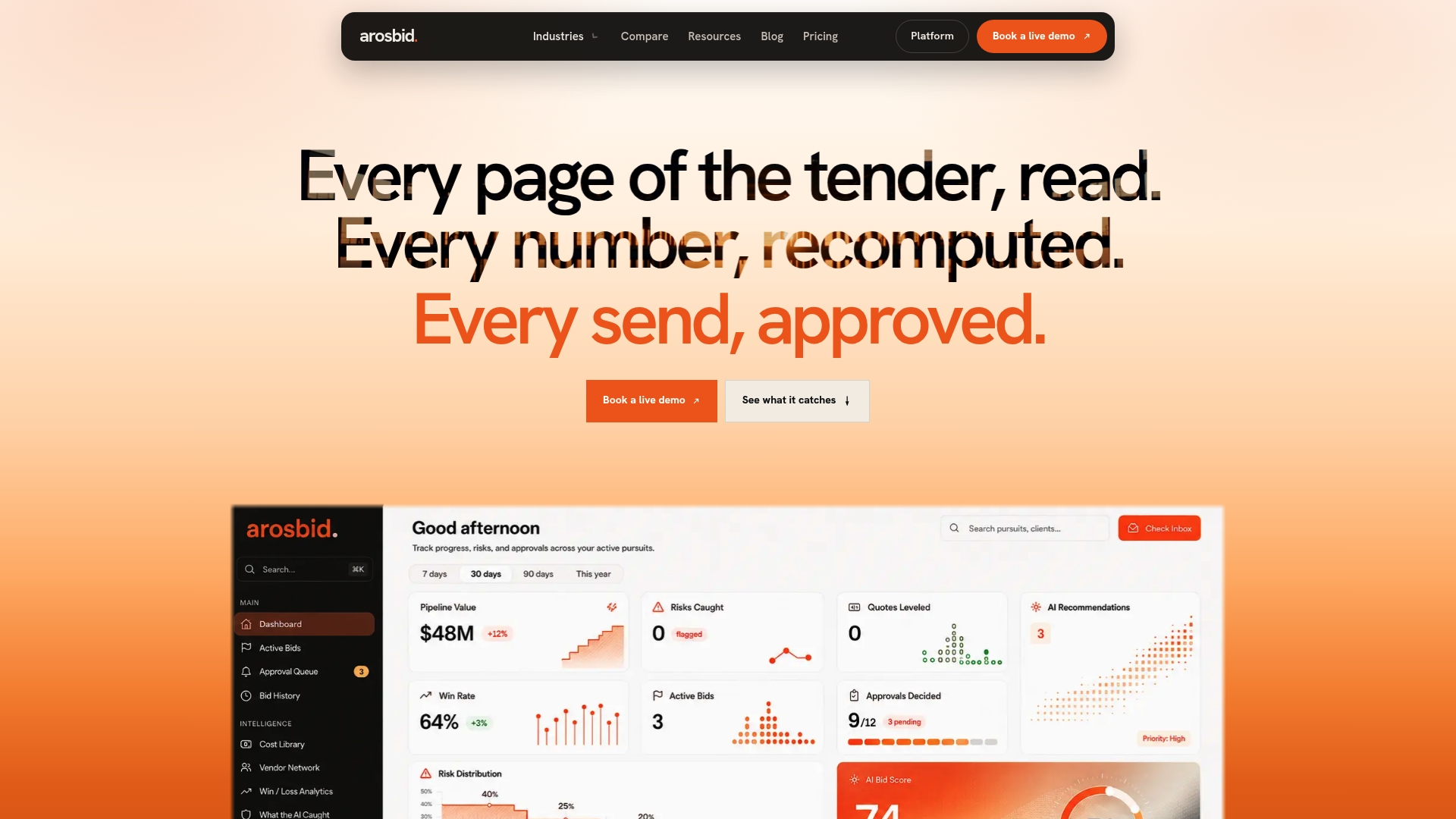
Everything above works better with less manual effort when the register, the compliance checks, and the document review live in one place instead of scattered across emails and spreadsheets. We built ArosBid’s bid command center to read the full set of bid documents, including front-end clauses, and flag the kind of missed detail that debriefs keep surfacing as a recurring cause of disqualification.
- Automated compliance checks catch clause and document gaps before submission.
- Action registers stay attached to the bid, not buried in a separate tracker.
- Native Excel and Outlook integration means your team keeps its current workflow.
We offer three plans, One Desk, The Department, and The Whole Year, with pricing available on request. Book a demo to see how a command center closes the loop on your own bid lessons.
FAQ
What are examples of lessons learned?
Common examples include missing an addendum deadline because no calendar alert was set, underestimating a scope item due to an unclear specification, or losing a shortlist spot because the fee breakdown confused the client. Each becomes useful only once it’s logged with a root cause and an assigned fix.
What to say instead of “lessons learned”?
Teams often use “debrief findings,” “post-bid review,” or “action register” depending on whether they mean the session, the output, or the tracking document. The phrasing matters less than whether each item gets an owner and a due date.
What are some lessons that can be learned?
Bid teams typically learn about gaps in scope assumptions, unclear fee presentation, missed compliance items, and weak differentiation against competitors. The AIA’s loss-debrief guidance points to selection criteria and proposal clarity as two of the most frequent themes clients raise.
How do I run a useful debrief when time is short?
Use a 10 to 20 minute quick debrief with three questions: what changed since the estimate, what was missed in scope or assumptions, and what single action would prevent it next time. A short session held promptly beats a longer one scheduled weeks later.
Sources
The guidance above draws on established debrief practice and practical bid-management resources worth bookmarking:
- AIA — How to conduct a successful loss debrief (best practices)
- Anova Group — Win-loss analysis & debrief insights