Construction Bid Handoff: What to Pass On and Who Owns It
Construction Bid Handoff: What to Pass On and Who Owns It ! Construction bid handoff title card illustration A construction bid handoff is the moment the knowledge behind a bid moves to the people who will deliver the job.

A construction bid handoff is the moment the knowledge behind a bid moves to the people who will deliver the job. It covers the estimate, the scope assumptions, the vendor quotes, the exclusions and the open questions. Done well, the project manager starts with the same picture the estimator priced. Done badly, the team finds exclusions, promises and owner quirks after mobilization, when fixing them costs money. This guide shows what belongs in the handoff, who owns each part, how to track it, and how to tell whether it is improving.
TL;DR
- A bid handoff is a formal transfer of scope, assumptions, quotes, risks and open items from the bid team to whoever runs the work. Treat it as a stage with an owner, not a single meeting.
- Hold it early. Public owners’ own manuals say the hand-off meeting should not necessarily wait for contract execution or notice to proceed.
- Pass on the basis of estimate, inclusions and exclusions, dated vendor quotes, alternates, risk flags with named owners, and the questions still unanswered.
- Catch gaps before submission, not after award: compare the invitation against plans and specs, keep a gap register, and have a second reviewer read the compliance requirements.
- Measure the process with a few simple counts, such as surprises logged in the first 60 days and quotes that expired before buyout.
Table of Contents
- What a construction bid handoff actually is
- When the handoff should happen
- What belongs in the handoff packet
- Who is responsible for each step
- Catch gaps before the bid leaves the building
- Track versions, quotes, questions and approvals
- Fit the handoff into the tools you already use
- Measure whether your handoff is improving
- Our perspective on the handoff
- See the bid cycle in one place
- FAQ
- Sources
What a construction bid handoff actually is
The term gets used for two related things, and it helps to separate them.
The first is the transfer from estimating to operations inside a contractor. The estimator or bid manager hands the priced job to the project manager and superintendent. The second is the transfer on the owner’s side, from the procurement team that ran the solicitation to the staff who administer the contract.
The second is well documented. The Oregon Department of Transportation’s Design Build Contract Administration Manual describes the hand-off meeting as the formal transition from procurement to the design and construction phase. It adds that the meeting should not necessarily wait until after contract execution or notice to proceed, because many aspects of the project require training for the administering team.
The lesson applies to contractors too. The handoff is not paperwork after the win. It starts while the bid is still alive, because that is when the person who knows why a number was chosen is still at the desk.
Architect Michael Plottel makes a related point on the AIA Community Hub. Contract documents, like any complex text, tell a story that needs guidance and study to transfer knowledge, and the architect has a role after award in getting the general contractor up to speed. For a subcontractor or trade desk, the same logic holds one level down: whoever priced the documents is the best person to explain them.

When the handoff should happen
There are three natural points, and strong teams use all of them in lighter or heavier form.
- At bid/no-bid. The first handoff is from the person who found the opportunity to the person who will price it. It carries the owner, delivery method, due date, bonding needs and known risks.
- At submission. The bid package is frozen. Everything the approver saw gets stored with a date stamp, so nobody has to reconstruct it later.
- At award. The formal handoff to operations, ideally within days. A kickoff shortly afterward turns the packet into a plan.
If you only do the third, you are relying on memory of a bid that may be weeks old, with addenda and quote changes buried in email.
What belongs in the handoff packet
No single standard defines the packet, but several published checklists and manuals agree on the core. Plottel suggests requiring three items in the instructions to bidders and treating them as submittals due immediately on award: the construction schedule with critical path, the schedule of shop drawings and submittals, and evidence of timely subcontractor buyouts. That is an owner-side view, but a contractor can adopt it as an internal standard.
From the contractor’s side, here is a practical packet. It is our synthesis of what a project manager needs, not a regulatory list.
| Packet section | What goes in | Why the field needs it |
|---|---|---|
| Bid documents | Final invitation or RFP, every addendum, drawing and spec versions with dates | Proves which set was priced |
| Basis of estimate | Quantities, units, productivity assumptions, allowances, contingency | Lets the PM defend or adjust the number |
| Scope boundaries | Inclusions, exclusions, clarifications, alternates, not-in-contract items | Prevents scope arguments in month two |
| Vendor quotes | Price, scope covered, exclusions, expiration, leveling sheet | Starts buyout with real numbers |
| Contract terms | Prime contract or subcontract, bonds, insurance, schedule, liquidated damages, payment terms | Surfaces obligations before they bite |
| Risk and open items | Risk flags with named owners, unanswered questions for the owner or designer | Keeps known unknowns from becoming surprises |
| Schedule logic | Durations and sequence used in pricing | Shows what the price assumed about time |
For the proposal side of this transfer, our walkthrough of the estimating to proposal handoff shows how the estimate becomes the document the owner reads.
Keep exclusions and clarifications visible
The most expensive line in a packet is often the one never written down: what the bid left out. List every exclusion and clarification exactly as it went to the owner, and note which ones the owner accepted. If you want examples of how those statements are worded, see these proposal clarifications examples.
Date-stamp everything that expires
Vendor quotes carry expiration dates, and addenda change documents. A packet that says “quote from the electrical sub” without the amount, scope and expiration is a reminder that a quote exists, not a record of it. Put the price, the date and the expiration beside every vendor line.
Who is responsible for each step
The clearest lesson from public owners is that handoffs have named roles and signed checks. The examples below come from owners’ manuals, which describe their own processes, not a universal rule.
- The Houston Public Works Construction Management Process Manual says that after award the Engineering Branch Project Manager conducts the handoff meeting. An administrative assistant reviews the package against a Project in Processing Checklist, signs it and tells the project manager it is ready for pickup. The project manager then collects the documents.
- The Port Authority of New York and New Jersey Contracts Unit Standards have the Contract Engineer prepare the contract book from questionnaire information and other elements, such as the engineer’s estimate, permits, time for completion, milestones and liquidated damages. The engineer must complete and sign QC and QA checklists.
- The Alameda CTC Construction Management and Administration Guide describes bid analysis and protest resolution before a staff report recommends award to the lowest responsible responsive bidder. The contract administrator then reviews the contractor’s submitted documents before routing for approval.
The common thread is separation of duties. The person who assembles the package is not the only person who checks it, and someone signs to say it is complete.
A simple role split for a contractor
| Step | Owner | Checker |
|---|---|---|
| Assemble packet | Estimator or bid manager | Senior estimator |
| Approve bid assumptions | Executive or division lead | Not the preparer |
| Receive and acknowledge | Project manager | Operations lead |
| Confirm open items closed | Project manager | Estimator |
The receiving project manager should sign off that the packet is usable. If they cannot explain the exclusions after reading it, the packet is not finished.
Catch gaps before the bid leaves the building
A bad handoff often starts as a bad bid. A missed clause, a conflict between drawing and spec, or an outdated addendum travels straight into the packet. Three habits reduce the risk.
Compare the invitation against the documents. Read the front-end requirements alongside plans, specifications, schedules and site conditions. Record each mismatch in a gap register: what conflicts, which document says what, who is resolving it, and how it was priced or clarified.
Run compliance as pass/fail first. Before pricing finesse, confirm the bid can be accepted at all: forms, bonds, licenses, signatures, required alternates. Our bid compliance checklist breaks this into six phases.
Use a second reader. Where possible, the person doing the line-by-line compliance review should not be the person who built the whole estimate. Fresh eyes catch what familiarity hides. A three stage estimate review checklist gives the review a structure.
The pre-bid stage also feeds the handoff. Questions raised at the job walk, and answers given, belong in the packet. Our pre-bid meeting checklist covers the agenda and walk.
For large document sets, software can read the full package, including front-end clauses, and flag conflicts for a person to resolve. That is the idea behind AI tender review for construction bids: the tool surfaces issues, and people keep authority over what is submitted.

Track versions, quotes, questions and approvals
The handoff only works if the underlying records are clean before it starts. Four trackers matter.
Bid versions
Name every set with a date and addendum number, and store the one that was priced in a locked folder. When a revised drawing arrives after submission, log it against the version rather than overwriting. The field should always be able to answer the question: which set did this number come from?
Vendor quotes
Track each quote by trade, vendor, amount, scope covered, exclusions, and expiration. Level quotes on the same scope basis before comparing totals, because a low number with a missing scope item is not low. A process for this is laid out in our bid tabulation guide, and trade desks can see how vendor quote leveling handles the comparison. Carry the leveling sheet into the handoff so buyout starts from it.
Open questions
Keep a list with the question, who it went to, when, and the answer. Items still unanswered at handoff stay on the list with an owner, and the project manager inherits them knowingly.
Approvals
Record who approved the bid, on what version, with what assumptions in front of them. A good approval summary shows the final price, major assumptions, risks, alternates, exclusions and compliance status. That way the approver knows what the company is offering, and the record later shows what was known when the decision was made.
Fit the handoff into the tools you already use
Most firms already work in Excel, Outlook and a takeoff or project management tool. Replacing them for the sake of a handoff is rarely realistic. The goal is to avoid retyping.
Three rules help:
- One source per fact. The estimate lives in one place, quotes in one place, questions in one place. The packet links or exports from them rather than copying.
- Capture at the moment of work. If a quote arrives by email, it gets logged when it arrives, not at handoff time.
- Export, do not re-enter. The cost data that goes to the project manager’s budget should come from the estimate file, not a fresh spreadsheet.
The takeoff stage matters here too. If quantities can be traced to the estimate, the project manager can audit them later. Our takeoff to estimate workflow shows how to make that trail auditable.
Measure whether your handoff is improving
You do not need a dashboard to start. Pick a few counts and review them after each awarded job.
- Surprises logged in the first 60 days. Count scope items, exclusions or owner requirements the project team says they did not know about at award. This number should fall.
- Change orders traced to bid scope. For each, note whether the item was a true owner change or something in the original documents the bid missed.
- Expired quotes at buyout. How often did you reach buyout and find a quote past its date?
- Packet completeness at award. Out of the packet sections, how many were complete and signed within a week?
- Disqualification or rejection reasons. Track bids rejected on compliance, not price.
- Time to first kickoff. Days between award and the handoff meeting.
Hold a short debrief after each job where the project manager and estimator compare the packet with what actually happened. Record the findings in a historical cost and notes library so the next estimate benefits. These measures are internal indicators, not industry benchmarks, so compare yourself with your own past results.
Our perspective on the handoff
Most handoff problems we hear about are not communication failures at the kickoff. They are information failures upstream: a clause nobody read, two specs that disagreed, a quote that quietly expired. By the time the packet is assembled, the damage is baked in.
That is why we built ArosBid around the whole bid cycle instead of a single step. Our approach is designed to read the entire document set, including front-end clauses, check for errors and conflicts, and keep a structured record of quotes, approvals and compliance as the bid develops. People keep authority over what is submitted. The software does the tedious reading and tracking.
When the work is captured as it happens, the handoff becomes an export of facts already in order, not a scramble to reconstruct them. Because we work with Excel and Outlook and with the takeoff, cost and project management tools teams already use, nobody has to abandon their estimating habits to get there.
arosbid team
See the bid cycle in one place
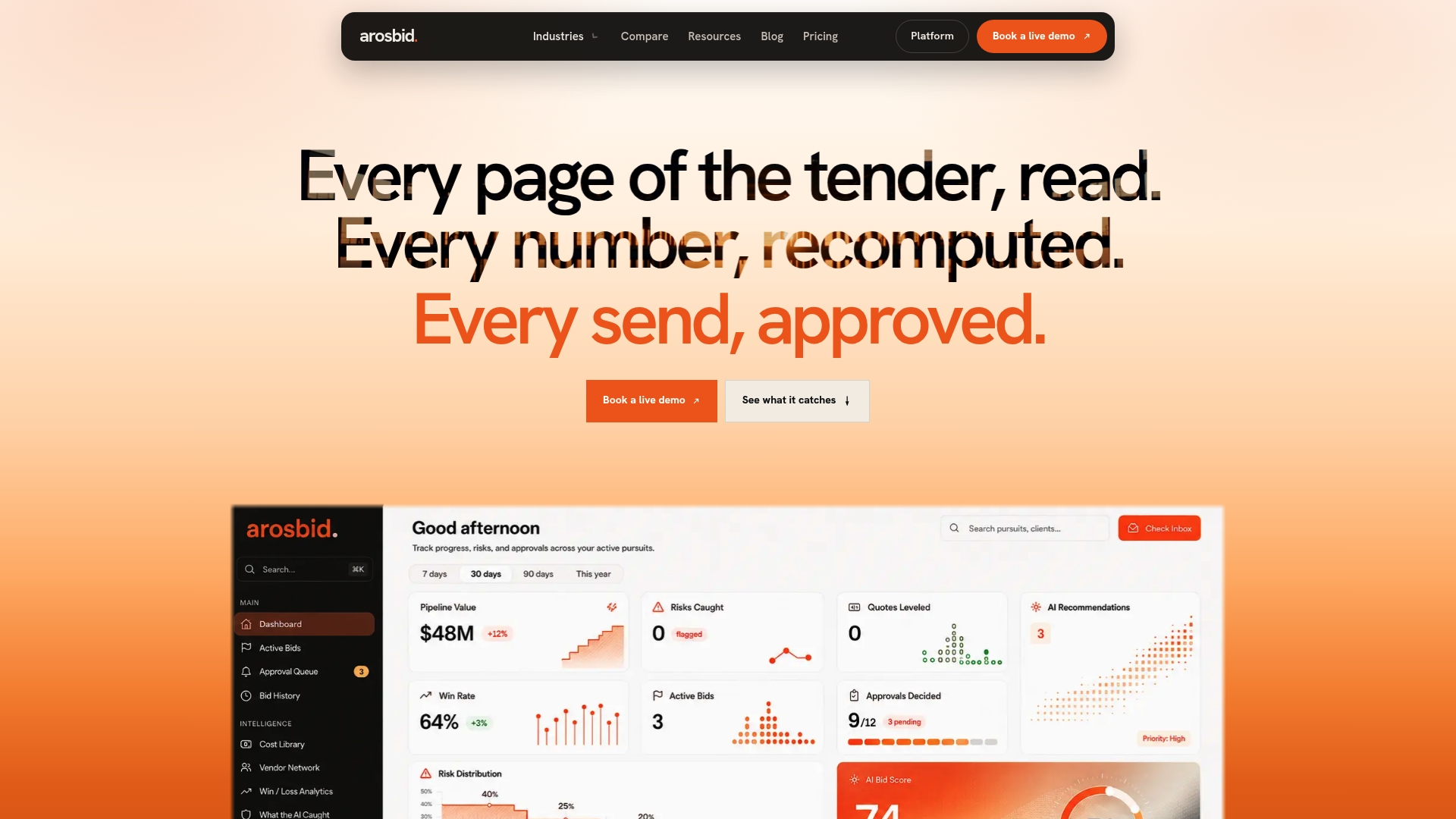
If your handoff packets are assembled by hand each time, ArosBid can carry the record from intake through buyout and debrief: document review, compliance checks, takeoff, estimates, vendor quote tracking and leveling, bid/no-bid evaluation, proposal assembly and a historical cost library. Look at the Bid Process Platform to see how it fits together, or book a live demo and bring a recent bid to walk through.
Plans are listed on the pricing page. For desk-level use, see construction estimating and bidding software.
FAQ
What is the difference between a bid handoff and a project kickoff?
The handoff transfers information: the packet, assumptions, quotes and open items. The kickoff is the meeting where the project team turns that information into a plan. Hold the handoff first, so the kickoff starts from a shared picture instead of discovering one.
Who should run a construction bid handoff?
The estimator or bid manager who built the bid should lead it, and the project manager who will run the job should receive it. A second person, such as a senior estimator or operations lead, should check the packet. Public owners’ manuals, like Houston Public Works, also name a signing role to confirm the package is complete.
Do small jobs need a full handoff?
They need a shorter one, not none. A one-page summary covering scope, exclusions, quote amounts and expirations, open questions and schedule assumptions is enough for many small jobs. The risk of an unrecorded exclusion does not shrink with job size.
When should the handoff meeting be held?
Soon after award, and ideally with preparation underway before it. Oregon DOT’s design-build manual notes its hand-off meeting need not wait for contract execution or notice to proceed. For contractors, that means assembling the packet at submission so the meeting takes minutes of preparation.
How do we keep the handoff from duplicating data entry?
Keep one record for each type of information and export from it. Log quotes and questions when they arrive, and let the packet pull from the estimate file and quote tracker. Tools that integrate with Excel and Outlook make this easier because the data stays where your team already works.
Sources
- Design Build Contract Administration Manual, Oregon Department of Transportation
- Knowledge Transfer aka the Bid Handoff, AIA Community Hub
- Construction Management Process Manual, Houston Public Works
- Contracts Unit Standards, Port Authority of New York and New Jersey
- Construction Management and Administration Guide, Alameda CTC