Subcontractor Bid Leveling: A Practical Guide for Estimators
Subcontractor Bid Leveling: A Practical Guide for Estimators ! Sketches of plans and bid documents frame the title Subcontractor bid leveling is the process of adjusting every quote you receive for a trade to the same scope, so the numbers can be compared fairly.

Subcontractor bid leveling is the process of adjusting every quote you receive for a trade to the same scope, so the numbers can be compared fairly. The low number on the page is rarely the low price. It is often the quote that left something out. Leveling finds what each sub included, excluded, assumed or qualified, puts a value on the difference, and leaves you with a recommendation you can defend.
This guide walks through the whole job: preparing the scope, building the comparison sheet, handling exclusions, alternates and conflicting specs, talking to subs fairly, and recording what you did.
TL;DR
- Level to one written scope baseline, not to the lowest quote. Every line of the baseline gets a status from every sub: included, excluded, qualified or not priced.
- Adjust for gaps with a stated source for each number: a competing quote, a historical cost, or your own takeoff. Never plug a figure from memory without noting where it came from.
- Compare on the same basis: same tax treatment, same alternates, same unit-price assumptions, same schedule and bond terms.
- Call subs to clarify, and treat all bidders the same. Scope gaps that are large enough may justify a revised scope or a rebid.
- Keep a one-page record of every adjustment so the award can be checked later.
Table of Contents
- What bid leveling actually does
- Step 1: Define the scope before you compare anything
- Step 2: Build the leveling sheet
- Step 3: Normalize the basics
- Step 4: Handle exclusions, qualifications and scope gaps
- Step 5: Clarify with subs, and do it fairly
- Step 6: Adjust, rank and recommend
- Documenting the evaluation
- Where our perspective comes in
- Doing it in spreadsheets or with software
- A short worked example
- FAQ
- Sources
What bid leveling actually does
A subcontractor quote is a sales document. It tells you what the sub will do for a price, in the sub’s words, with the sub’s assumptions. Two quotes for the same drywall, mechanical or electrical package can describe two different jobs. One includes patching and cleanup. The other excludes hoisting, permits and after-hours work. Put the totals side by side and you are comparing a job to a fraction of a job.
Leveling turns those quotes into like-for-like numbers. The output is a short list of adjusted prices, each with a note on what was added or removed to get there, and a clear view of which sub carries the most risk.
It also does something less obvious. It shows you where your own bid documents are unclear. If three subs read a spec section three ways, the problem may not be the subs.
Step 1: Define the scope before you compare anything
You cannot level against a scope that only exists in your head. Before quotes come back, write the scope for each trade package and send the same package to every invited sub.
A workable scope package includes:
- The drawing sheets and specification sections that apply, by number and revision.
- Addenda issued to date, with the date of the last one.
- What the GC or owner supplies, and what the sub supplies and installs.
- Interfaces with adjacent trades, such as who provides motor starters, who cuts and patches, who does fire caulking.
- General conditions that touch the trade: schedule, phasing, working hours, site access, hoisting, temporary power, bonding, insurance, retainage and payment terms.
- The bid form you want back, so quotes arrive in a similar shape.
The most common cause of unlevelable quotes is a package that was loose to begin with. Reading the full document set, front-end clauses included, before you send it out is the cheapest leveling step there is. Our walkthrough of bid document review in five steps covers what to look for, and the subcontractor RFQ process shows how to structure the request itself.
Guidance from the public sector points the same way. New York State’s Office of General Services recommends a bidder question-and-answer period during solicitation, which gives subs a formal place to flag unclear scope before they price it. Questions answered in writing, and shared with everyone, cut down the assumptions you will have to chase later.
Step 2: Build the leveling sheet
A total-price column per sub is a ranking, not a leveling sheet. A useful sheet has rows that follow your scope, one column per sub, and a notes column.
The core layout
| Scope item | Spec or drawing ref | Sub A | Sub B | Sub C | Adjustment and source |
|---|---|---|---|---|---|
| Base scope, as bid | Per bid form | Price | Price | Price | None |
| Hoisting and lifting | Spec front end | Included | Excluded | Included | Add Sub B cost, from Sub A’s priced line |
| Permits and fees | Division 01 | By GC | Included | By GC | Remove from Sub B or add to others, per baseline |
| Cutting, patching, firestopping | Drawings, interfaces | Included | Included | Not priced | Ask Sub C, hold estimate until answered |
| Alternates | Bid form | Priced | Not priced | Priced | Request from Sub B |
| Unit prices | Bid form | Provided | Provided | Missing | Request from Sub C |
| Bond, insurance, schedule | General conditions | Meets | Meets | Qualified | Note qualification |
| Adjusted total | Total | Total | Total |
The real sheet will have more rows, but the logic is constant. Every sub gets a status on every row. A blank cell is not allowed, because a blank is where the gap hides.
Separate three kinds of numbers in the sheet:
- The quoted number. Exactly what the sub wrote.
- Adjustments. Each one a separate line with a reason and a source.
- The adjusted number. Quoted plus adjustments.
Mixing these makes the sheet impossible to audit. Keeping them apart lets a second estimator, or you six months later, see how the final figure was built. For layouts by trade and a checklist, see our quote comparison matrix guide.
Step 3: Normalize the basics
Before scope, make sure the quotes are on the same footing.
- Taxes. Decide whether you compare before or after sales tax, and whether the sub’s price includes it. Material-only quotes and installed quotes often treat tax differently. Compare on one basis.
- Quantities. If a sub priced from its own takeoff, note whether its quantities match yours. A sub who counted 40 devices fewer than you did not find a bargain.
- Validity and escalation. Note how long the price holds and whether material is escalation-protected. A cheaper quote that expires before award is not cheaper.
- Payment and retainage. Terms that differ from your subcontract form carry real cost.
- Units and allowances. Make sure allowances are the same amount, and that lump sums really cover the same thing.
One published example from a commercial estimating guide describes the same discipline: adding the cost of missing scope and converting money-related terms so each offer is compared on one basis, with tax treatment applied consistently. The principle holds in any market.
Step 4: Handle exclusions, qualifications and scope gaps
This is the heart of leveling, and where bids are won or lost.
Exclusions
Read every exclusion against your baseline. Sort each one into three groups:
- Normal and expected. Items that no sub in this trade would carry, and that your baseline assigns elsewhere.
- Required scope that was pushed back to you. These need a price. Use another sub’s priced line for the same item, your own estimate, or a historical cost, and record which.
- Unclear. Call the sub. Do not guess.
Watch for exclusions hidden in the fine print of a cover letter or a footer. They count just as much as the ones on the bid form.
Qualifications
Qualifications are conditions: “price valid if started by,” “based on one mobilization,” “excludes work above 20 feet,” “subject to approved submittals.” Treat each one as a risk with a cost. Some can be priced. Others, such as a restriction on schedule you cannot meet, can disqualify the quote outright.
Scope gaps
A gap is scope that nobody priced. It often sits between two trades, such as the controls wiring between mechanical and electrical, or the sealant at the joint between storefront and masonry. Finding a gap across all quotes is a sign the baseline needs a clearer interface line. Our article on scope gaps in quotes explains how to catch them before bids lock and what it does to your rights if you miss them.
Alternates and unit prices
Price alternates and unit prices on the same basis for every sub. If one sub left the alternate blank, request it. If you cannot get it, say so in the sheet. Do not compare one sub’s base plus alternate with another’s base alone.
Conflicting specifications
When drawings and specs disagree, subs often resolve it differently. One prices the heavier product. Another prices the lighter one. Level to the controlling document under the contract’s order of precedence, and raise an RFI or addendum request when the conflict is real. Record the decision in the sheet.
Step 5: Clarify with subs, and do it fairly
Calling subs is part of leveling, not a sign that something went wrong. Experienced estimators do it routinely, and two habits keep it clean.
Ask about scope, not about price. “Does your number include hoisting?” is a scope question. “Can you sharpen your price?” is a negotiation and belongs to a later stage, if at all.
Treat bidders the same. If one sub’s answer reveals a scope item that changes the baseline, tell every sub, in writing. Do not let one bidder fix its quote with information the others never received.
The New York guidance cited above says that after bids, reviewing the scope with the apparent winner can close remaining gaps, and that if bids come in significantly out of line with expectations, the scope may need revising and the work rebid. That is public procurement guidance, and private work has more freedom, but the logic is useful on any job. If every quote is far from your estimate, suspect the documents before you suspect the market.
A few practical habits:
- Send clarification questions by email, so the answer is in writing. A one-page bid audit trail keeps five-minute phone clarifications from disappearing.
- Use high quotes to learn. A sub who is far above the others may have found something real, or may be busy and pricing for risk. Ask which.
- Do not reveal one sub’s price to another.
Step 6: Adjust, rank and recommend
Once each sub has a status on every row, the adjusted totals tell the story. Rank by adjusted total, then look past it.
| Question | Why it matters |
|---|---|
| How large were the adjustments? | A quote that needed a lot of added scope carries more uncertainty. |
| Were adjustments confirmed or estimated? | A confirmed number is firmer than your own plug figure. |
| Does the sub have capacity, safety record and references for this job? | The cheapest sub that cannot staff the work is expensive. |
| Does the quote match the schedule? | Late delivery has its own cost. |
| How do qualifications change risk? | Some shift risk back to you at award. |
The lowest adjusted price is not automatically the winner, but the reasons to pass it should be written down. For the broader bid-tabulation workflow, including unit price checks, see our guide to the bid tabulation process.
Documenting the evaluation
Every adjustment should be written down with its source so the recommendation can be checked, challenged and audited. That one habit prevents most arguments after award.
For each adjustment, record:
- What was added or removed, and the line it touches.
- The amount and how you got it: another sub’s priced line, a historical cost, your own takeoff, or a written answer from the sub.
- Who confirmed it and when.
- The addendum or document version it was based on.
Then keep three things together: the quotes as received, the leveling sheet, and the clarification emails. If a sub later claims it never excluded something, or a change order appears for an item that sat in a gap, you can show what was known at bid time.
Mistakes that undermine leveling
- Leveling to the lowest bid. The baseline drifts toward whoever left the most out.
- Averaging. An average of mismatched quotes is a mismatched number.
- Unsourced plug figures. If nobody can tell where a number came from, it will not survive review.
- Skipping the front-end documents. Bond, insurance, schedule and payment clauses often change the real price.
- Missing addenda. A sub who priced before the last addendum is not on your baseline.
- Rushing the last day. Most quotes arrive close to the deadline. Plan time for leveling, not only for receiving.
Where our perspective comes in
We built our platform around a simple observation: most leveling errors are not math errors. They are reading errors. A clause on page 12 of the front end, a spec section that contradicts a drawing note, an exclusion buried in a vendor’s cover letter. These are the items that turn into disqualifications or into change orders nobody can bill.

That is why we pair automation with human authority. Software is good at reading every page of a bid set and every line of a quote, and at flagging what does not line up. It should not decide who gets the award. The estimator keeps that call, with the evidence laid out in front of them.
We also think leveling should not live in a separate tool from the rest of the bid. A quote is tied to a scope, which is tied to an estimate, which is tied to a proposal and, later, to buyout and debrief. When the vendor quotes, adjustments and clarifications sit in one place and connect to the Excel and Outlook files your team already uses, nobody has to retype and nothing gets lost.
— arosbid team
Doing it in spreadsheets or with software
A spreadsheet works for a small bid with a few subs per trade, if you hold to the structure above. It strains when you have many trades, many addenda and a short deadline. Typical failure points are version confusion, quotes living in inboxes, and adjustments that no one can trace.
Software helps most in three places:
- Intake. Pulling inclusions, exclusions and qualifications out of quote PDFs and emails.
- Matching. Lining up each quote against your scope and flagging gaps and conflicts with the documents.
- Record keeping. Keeping a trail of who said what, and when.
If you want to see how that works for trade RFQs, our page on AI bid leveling describes the approach, and AI tender review covers reading the bid documents themselves. The platform runs from intake through buyout and debrief, and works alongside Excel and Outlook rather than replacing them. You can see how it fits your team on the construction bid management software page, and the available plans are listed on our pricing page.
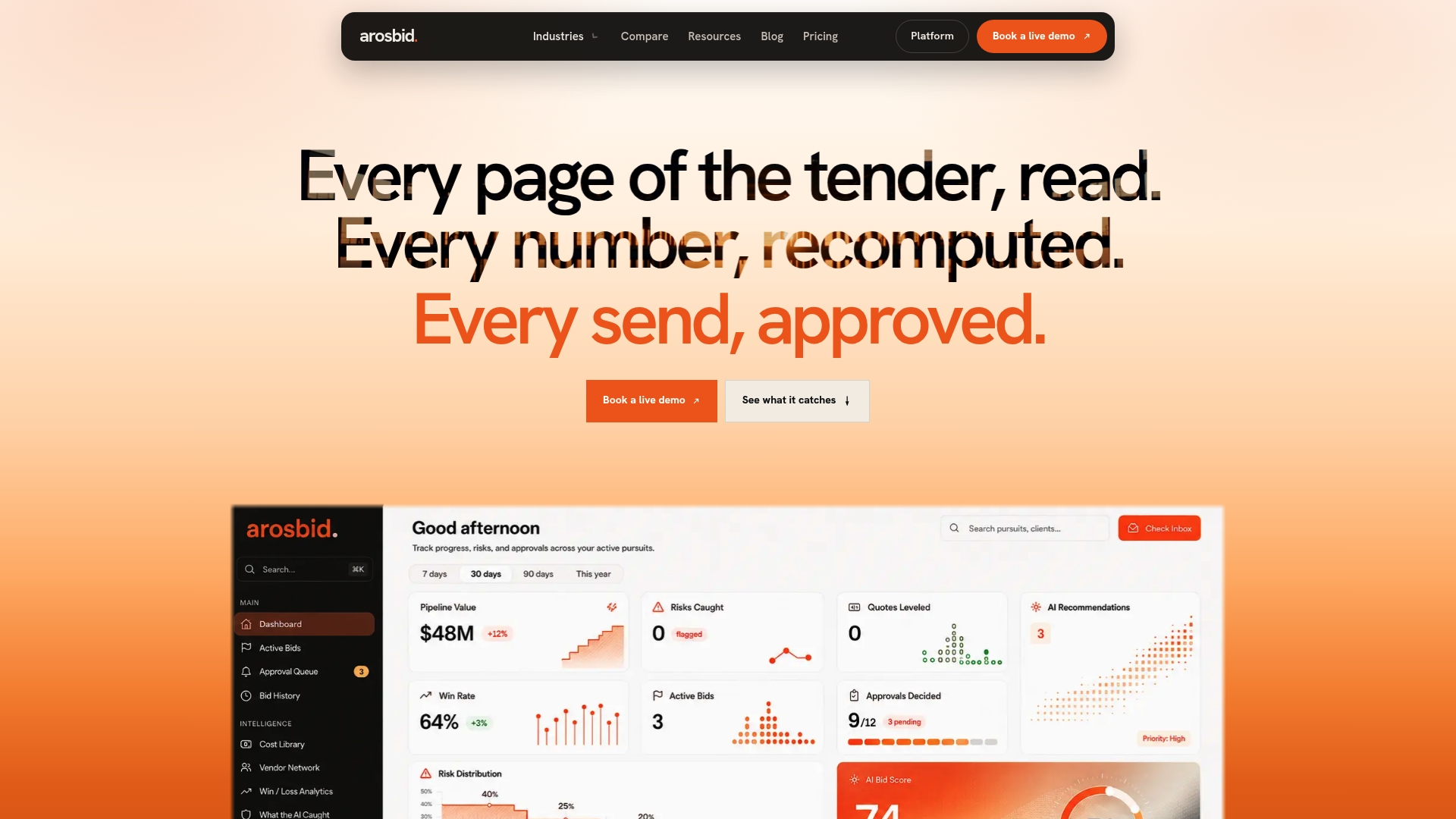
If your team levels in spreadsheets today, a good first test is to run one live bid through a structured process and compare what the review catches against what you would have found by hand.
A short worked example
Say you have three quotes for a mechanical package.
- Sub A: base price, includes hoisting and permits, excludes controls wiring.
- Sub B: lowest base price, excludes hoisting, includes permits, includes controls wiring, no alternate pricing.
- Sub C: highest base price, includes everything, qualifies price on a single mobilization.
Your baseline says the mechanical sub provides hoisting and permits, and the electrical sub provides controls wiring.
Leveling goes like this. You add hoisting to Sub B, using Sub A’s priced line as the source and confirming with a call. You note that Sub B’s controls wiring is outside baseline, so you deduct it, or if the electrical sub has not priced it, you flag it as an interface to resolve. You add a controls wiring allowance to Sub A only if the electrical quotes also leave it out. You request Sub B’s alternate. You check whether Sub C’s single mobilization matches the phasing in the documents.
When you finish, Sub B may still be lowest, or it may sit between the others. Either way, the recommendation is based on the same scope, and each change has a source you can point to.
FAQ
What is the difference between bid leveling and bid tabulation?
Tabulation lists the numbers from each bid side by side. Leveling goes further and adjusts those numbers for scope differences so they are truly comparable. Most teams tabulate first, then level.
How many subcontractor quotes do I need per trade?
There is no universal number, and requirements can come from the owner, the contract or public procurement rules. Three is a common target because it gives you a range to test against. For specialty trades, you may only get one or two, and then your own estimate becomes the check.
Should I level every quote or only the lowest few?
Level at least the quotes that could realistically win, and look closely at the lowest, since it is the most likely to hide missing scope. A very high quote is worth a call too, because it can reveal a risk you missed.
What do I do when a sub will not clarify?
Treat the unclear item as unpriced, assign it a sourced estimate, and note that the sub did not confirm. A sub who will not answer scope questions before award is likely to be harder to manage after it.
Can I share one sub’s price with another to get a better number?
Do not. It damages trust and can create legal and ethical problems, especially on public work. Share scope changes with everyone, but keep prices confidential.