Bid Exclusions List: What to Include and How to Word It
Bid Exclusions List: What to Include and How to Word It ! Sketches of construction plans and bidding tools A bid exclusions list is the part of your proposal that states what your price does not cover.

A bid exclusions list is the part of your proposal that states what your price does not cover. A good one names each item, points to the drawing or spec section it comes from, and says who owns the work instead. A weak one is a pile of vague “by others” lines that either get ignored or get your bid thrown out of the comparison.
This guide shows what belongs on the list, how to word each line, which items to check by trade, and how to review the list against the documents before you submit.
TL;DR
- An exclusion says what your price leaves out. An inclusion says what it covers. An assumption says the condition your price depends on.
- Start with the usual suspects: demolition and haul-away, cleanup, permits and fees, testing and special inspections, hazardous material abatement, overtime, taxes, bonds and insurance.
- Cite the sheet, detail, addendum or spec section on every line, and name who is responsible for the excluded work.
- Review the list jointly (estimator and project manager) against the full document set, including front-end clauses, before the bid goes out.
- Keep one register of exclusions per bid so every line traces back to its source.
Table of Contents
- What a bid exclusions list is, and what it is not
- Common items on a bid exclusions list
- How to word an exclusion so it holds up
- Check the list against the documents
- When exclusions can get a bid rejected
- Comparing bids that exclude different things
- Track exclusions through the whole bid cycle
- Run your exclusion review in one place
- A short checklist before you submit
- FAQ
- Sources
What a bid exclusions list is, and what it is not
Three terms get mixed up on almost every proposal. An exclusion states what is explicitly not included, an inclusion defines what is provided, and an assumption describes the condition your price depends on. Keeping them apart makes the proposal easier to read and much harder to dispute.
| Term | What it answers | Example |
|---|---|---|
| Inclusion | What is in my price? | Furnish and install 5/8" Type X gypsum board on Levels 1 to 3 per Sheet A-601 |
| Exclusion | What is not in my price? | Removal and disposal of existing ceiling grid is excluded |
| Assumption | What must be true for this price to hold? | Existing electrical panel has capacity for the new loads |
| Clarification | How do I read an unclear or conflicting document? | Priced to the door schedule, not the room finish schedule, where they conflict |
The panel example is a useful one. Adequate existing panel capacity is an assumption. Replacing the panel, if it turns out to be undersized, becomes an exclusion because that work sits outside the base price. If you want more wording models for the last row of the table, our proposal clarifications examples cover it in detail.
Common items on a bid exclusions list
No list fits every job, but certain categories show up again and again. Common exclusions include permit and utility fees, testing and special inspections, hazardous material abatement, and trade-specific items. The same source suggests checking every bid for demolition and haul-away, cleanup, overtime, taxes, bonds and insurance requirements.
Use the list below as a prompt, not a template to paste.
General items to check on every bid
- Demolition and haul-away: removal of existing materials, disposal fees, dumpsters.
- Cleanup: daily, final and construction cleaning.
- Permits and fees: building permit, utility connection and tap fees, impact fees.
- Testing and special inspections: soils, concrete, welding, firestopping, third-party commissioning.
- Hazardous materials: asbestos, lead paint, contaminated soil, mold.
- Overtime and premium time: acceleration, night or weekend work.
- Taxes: sales, use, or other taxes not shown on the bid form.
- Bonds and insurance: bond premiums, builder’s risk, wrap-up or specialty coverage beyond your standard policy.
- Design and engineering: delegated design, stamped calculations, shop drawings beyond what the spec requires.
- Utilities and temporary services: temporary power, water, heat, hoisting.
Trade-specific items
This is where most disputes start, because each trade has scope that sits right on the boundary with its neighbor.
- Drywall and framing: blocking and backing, insulation, fire-rated doors and frames, paint, bulkheads, exterior sheathing.
- Mechanical: controls wiring, electrical connections, roof curbs, rigging and crane time, insulation, balancing and commissioning.
- Electrical: trenching and concrete encasement, fire alarm programming, temporary lighting, utility company charges.
- Roofing: deck repair or replacement, wet insulation removal, blocking, sheet metal by others, structural upgrades.
- Structural steel: field welding inspection, galvanizing, shop primer beyond spec, anchor bolts, miscellaneous metals.
- Underground and utilities: potholing, utility locating, restoration of pavement and concrete. A contractor who works in this field explains in its HDD bid specifications guide why separating excluded work from pricing assumptions about site conditions keeps bid documents clean.
If you bid MEP, roofing or steel, see how trade bid software organizes these checks by trade.
How to word an exclusion so it holds up
The most common mistake is writing an exclusion that is too short to mean anything. “Electrical by others” tells the reader nothing. Which electrical, shown where, and who is paying for it?
Effective exclusions should be specific and cite the relevant drawing, detail, addendum or specification section, and state the work and the responsibility involved. A reviewer should be able to open the cited sheet and see exactly what you left out.

A simple formula
Write each line with four parts:
- The work: what is excluded, in plain words.
- The location: the sheet, detail, addendum or spec section.
- The owner: who is expected to provide it (owner, GC, another trade).
- The consequence: what happens if it turns out to be required (for example, priced as a change order).
Before and after
| Weak | Stronger |
|---|---|
| Demo excluded | Demolition and disposal of existing partitions on Level 2 shown on Sheet AD-201 is excluded. Provided by GC. |
| Permits by others | Building permit and plan review fees are excluded. Our price includes only the mechanical trade permit noted in Spec 01 41 00. |
| Unforeseen conditions excluded | Price assumes existing slab is level within the tolerance shown in Spec 03 30 00. Corrective grinding or leveling is excluded and will be priced as a change if required. |
| No overtime | Overtime and premium time are excluded. Our schedule assumes a single shift as shown in Addendum 2. |
Keep the tone neutral
An exclusion is a boundary, not an argument. Skip commentary like “we cannot be responsible for poor design.” State the boundary and the next step, and put the list next to your scope and price so it is not buried in a footer.
Check the list against the documents
An exclusion only works if it fits the contract. Many public owners and agencies define scope broadly. King County’s procurement policy, for example, defines the scope of work to include work not specifically identified but incidental to, or needed to complete, that scope. If your exclusion removes something the contract treats as incidental to your scope, expect an argument.
Interpretation also matters. Caltrans, in its construction manual, says interpretations should be those a reasonable contractor would obtain from the contract documents, and cautions against pure technicalities or unreasonable inferences. An exclusion built on a hair-splitting reading of a spec is a weak position.
A five-pass review
- Front-end documents. Read the instructions to bidders, general conditions and supplementary conditions. Look for clauses that require items you were about to exclude (testing, cleanup, permits, bonds).
- Specifications. Search each division in your trade, and the related Division 01 sections, for work the spec places on you.
- Drawings. Check plans, details, schedules and notes. Flag anywhere the drawings and specs disagree.
- Bid form and addenda. Confirm the bid form does not restrict qualifications, and that every addendum is reflected in the list.
- Joint sign-off. Before submission, the estimator and project manager should review the exclusion list together to confirm it matches the actual project requirements.
Our 16 point scope of work review gives the project manager a structured version of the last step, and the pre-bid meeting checklist helps you raise unclear boundaries at the job walk while questions can still be answered in an addendum.
When exclusions can get a bid rejected
Some owners require a bid with no qualifications. An exclusion in that setting can make the bid non-responsive. Always check the instructions to bidders before you add a line, and confirm whether qualifications are allowed, limited, or must go in a specific place.

There is also a competitive trap. The AWCI’s Estimator’s Edge notes that some contractors use exclusions to lower a base bid so it reaches scope review, but that advantage only holds if the excluded items are not clearly identified in the tender or in the general contractor’s scope sheets. If the GC’s scope sheet already lists an item as yours, an exclusion will be spotted, and you may be asked to add it back or be leveled out.
Common errors
- Excluding something the spec explicitly assigns to your trade.
- Citing no document, so the reviewer cannot tell what you meant.
- Leaving out an addendum, so the list refers to superseded sheets.
- Using blanket language (“all unforeseen conditions”) that the reader treats as meaningless.
- Hiding exclusions in a cover letter that is not part of the bid form.
- Contradicting your own inclusions, such as including a pour and excluding its testing without saying so.
Comparing bids that exclude different things
If you are the one receiving bids, the exclusion list is how you find out that a low number is not really low. Build one consolidated list of every exclusion across all bidders, decide who owns each item, and add a value for anything you will have to cover yourself before you compare totals.
A practical way to do this:
- Put each bidder in a column and each scope item in a row.
- Mark every item as included, excluded or unclear.
- Price each excluded item, using an allowance or a follow-up quote.
- Send clarification requests for every unclear cell.
- Compare adjusted totals, not the numbers on the proposal.
Our quote comparison matrix and subcontractor bid leveling guide walk through the full method with trade checklists. If you tabulate a lot of bids, the bid tabulation process shows where unit price checks fit.
Track exclusions through the whole bid cycle
An exclusion list is not finished when you write it. It changes with every addendum, every vendor quote and every clarification call. Keep a single register for each bid that records:
- the exclusion wording,
- the source document and section,
- who reviewed it and when,
- whether a vendor quote carries the same exclusion,
- the status (open, resolved, sent to owner).
This makes every change traceable. When a vendor quote arrives with an exclusion your own list does not have, you see the gap the same day instead of at buyout. Our requirements tracking method shows how to turn clauses into a trackable list, and the 3 stage estimate review checklist gives you a place to check exclusions at each stage. For pass/fail items, use the bid compliance checklist first.
What we see in practice
Exclusion problems rarely come from a missing item on a list. They come from a document nobody read in full. A clause in the front-end documents that makes testing the sub’s cost, or a spec note that conflicts with a drawing, is the usual culprit.
That is why we built ArosBid to read the entire set of bid documents, including front-end clauses, and flag missed clauses and conflicting specifications before submission. We designed it to automate the checking, not to take authority away from your people: the estimator and project manager still decide what goes in the bid.
We also think the exclusion list should live inside the same workflow as vendor quotes, clarifications and approvals, and work with the tools your team already uses, such as Excel and Outlook, instead of asking you to replace them.
arosbid team
Run your exclusion review in one place
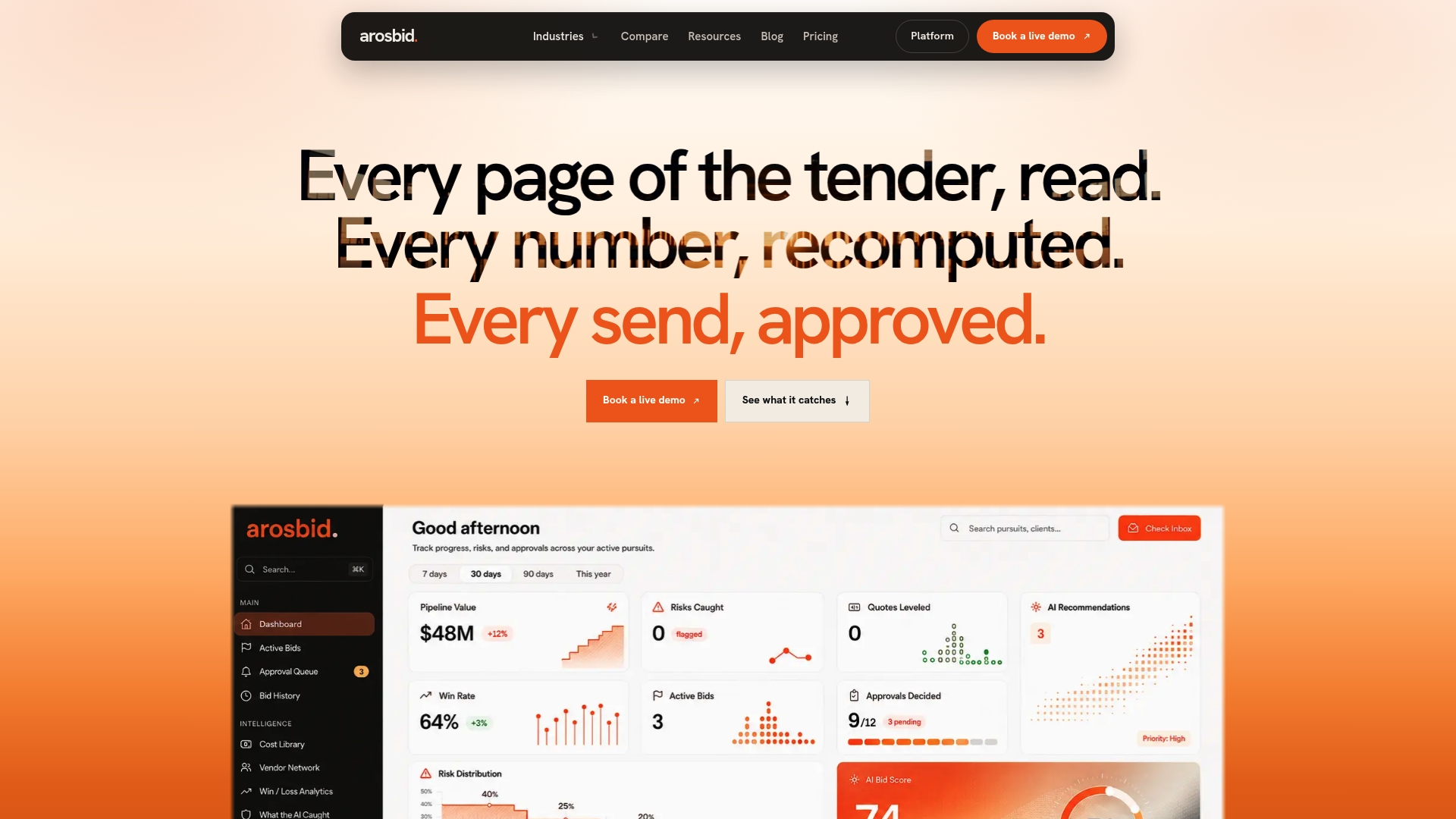
If your team keeps exclusions in spreadsheets, email threads and a marked-up PDF, each bid depends on someone remembering to reconcile them. ArosBid is bid management and estimating software for construction trades. It supports automated document review, compliance checks, vendor quote tracking and leveling, bid/no-bid evaluation, proposal assembly, buyout and debriefing, and it integrates with Excel, Outlook and major takeoff, cost and project management tools.
See how it fits your trade on the construction estimating and bidding software page, compare the One Desk, The Department and The Whole Year plans on the pricing page, or book a live demo and walk through one of your own bids.
A short checklist before you submit
- Every exclusion cites a sheet, detail, addendum or spec section.
- Every exclusion names who is responsible for the work.
- No exclusion removes work that the spec or contract assigns to your trade.
- The instructions to bidders allow qualifications, and yours sit where they should.
- Every addendum is reflected in the list.
- Vendor quote exclusions match or are covered by your list.
- The estimator and project manager have both signed off.
- The final list is saved with the bid so it can be reviewed at debrief.
FAQ
What is the difference between an exclusion and an assumption?
An exclusion names work or cost your price does not cover, such as replacing an existing panel. An assumption is a condition your price relies on, such as the panel having enough capacity. If the assumption fails, the related work is usually handled as a change.
How many exclusions should a bid have?
There is no right number. List what is actually left out of your price on this job and cite its source. A short, specific list is easier to defend than a long, generic one, and a list that mirrors the project documents is easier for reviewers to accept.
Can exclusions get my bid disqualified?
Yes, if the instructions to bidders do not allow qualifications or require a specific format. Read those instructions first, and check the bid form and any addenda before you add or move a line. If you are unsure, ask during the question period.
Should I copy exclusions from my last bid?
Use past lists as a starting prompt, not a final answer. Every project has different documents, owners and conditions, so each line should be checked against the current drawings, specs and addenda before it goes out.
Who decides what goes on the exclusion list?
The estimator drafts it and the project manager reviews it against the contract documents before submission. Having both look at it catches items that one person would read past.
Sources
- Bid Exclusions and Clarifications: How to Write Them
- Caltrans Construction Manual, Section 3-4 Scope of Work
- King County Construction Procurement Policy 7-26
- The Exclusion Illusion, AWCI Estimator’s Edge
- HDD Bid Specifications: What to Put in Your Bid Documents